
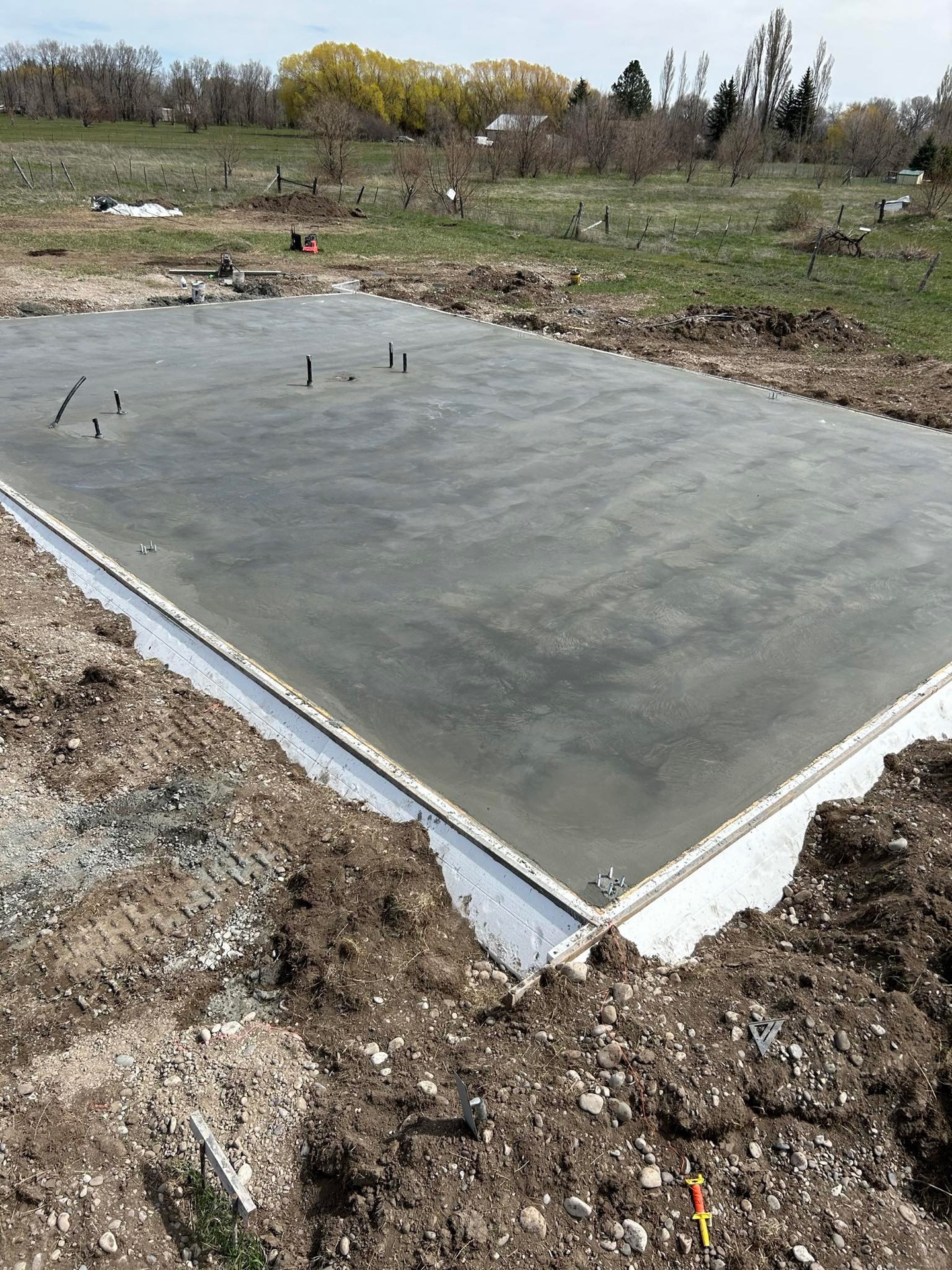
There is a moment on almost every pour where somebody wants water in the truck. Sometimes it is the driver. Sometimes it is a homeowner watching a stiff load come down the chute and deciding it looks wrong. Sometimes it is another sub who wants the concrete to move easier so he can get home.
I run Skinner Customs out of Rigby and pour across Jefferson, Bonneville and Madison counties. Water in the truck is the single easiest way to turn a good load of concrete into a mediocre slab, and it happens in about ninety seconds with nobody writing anything down. Here is what it actually does, what the standards allow, and where I draw the line.
Why the load shows up stiff in the first place
Concrete starts losing slump the moment it is batched. On the way out to a rural job in Jefferson County you can be looking at a long haul from the plant, a wait at the gate, and another wait while the crew finishes screeding the last truck. By the time that drum turns up at the chute, the load is less workable than it was when it left.
In July it is worse. Heat accelerates everything, and a load that was fine at the plant can arrive tight enough that it does not want to flow around a rebar grid. In November you get the opposite problem, where cold slows the set and the load stays workable longer than anybody expects.
So a stiff load is not a scandal. It is physics, plus distance. The question is what you do about it.
What the water actually does
Concrete strength is governed mostly by the ratio of water to cement in the mix. Add water without adding cement and you have changed the recipe, not just the consistency.
The National Ready Mixed Concrete Association covers this directly in its bulletin CIP 26, Jobsite Addition of Water, and the sentence worth memorizing is this one:
Addition of water in excess of the design mixing water will delay setting time, reduce strength, adversely impact durability, and increase the potential for cracking.
Four separate problems out of one hose. Slower set, lower strength, worse durability, more cracking. The same bulletin plots strength against water added, and the line drops off steeply. There is no version of this where free water is a free improvement.
The conversion is useful to know because it shows how little it takes:
A rule of thumb that works reasonably well is 1 gallon, or roughly 10 lb., of water per yd3 for 1 inch increase in slump.
A ten yard load is ten gallons a yard-inch. Three inches of extra slump on that load is thirty gallons of water nobody designed into the mix. That is not a splash. That is a trash can.
What the standards do allow
This is where it gets misrepresented in both directions. Water at the jobsite is not banned. ASTM C94, the ready mixed concrete specification, permits it inside limits, and CIP 26 lays out how:
Water addition can be in several increments accompanied by mixing to evaluate change in slump.
And then the conditions, which are the part that gets skipped:
ASTM C94/C94M requires an additional 30 revolutions of the mixer at mixing speed after the addition of all water or admixtures at the jobsite.
All water added to concrete on the jobsite must be measured and recorded on the delivery ticket.
After some concrete is discharged, no water addition is permitted.
Upon obtaining the desired slump and/or maximum water-cementitious materials ratio, no further addition of water on the jobsite is permitted.
Read those together and the real rule comes out. Water is allowed before the pour starts, inside the mix design, measured, written on the ticket, and followed by thirty revolutions of mixing. Water is not allowed halfway through a pour because the slab got hard to finish, and it is not allowed past the design water the plant already held back.
The bulletin also notes the ticket should show how much trim water the plant held back when it batched, which is what sets the ceiling. If you do not know that number, you do not know whether the gallon you just added was inside the design or outside it.
How it goes wrong on a real job
What CIP 26 describes is a controlled adjustment made by people who know the numbers. What usually happens on a residential pour is none of those things.
The load arrives, somebody says it looks dry, water goes in from a hose with nobody counting, the drum spins for maybe ten revolutions, nothing gets written on the ticket, and the pour starts. Nobody ever knows what that slab actually was. If it cracks badly in two winters, there is no record to look at.
And the worst version is water added to the last two yards, after most of the load is on the ground. Now you have one slab poured at two different water contents, with the wettest, weakest concrete sitting in whatever happens to get poured last. That shows up later as a soft, dusty patch that scales while the rest of the slab holds up.
What I do instead
My standard spec does not change because a load came in tight. Four thousand PSI minimum for this climate, air entrained for exterior work, number three or number four rebar on an eighteen-inch grid, four inches of compacted gravel base minimum and more on soft ground.
What I change is everything upstream of the hose:
- Order the right slump and tell the plant where the job is. The haul is part of the mix design conversation, not a surprise at the chute.
- Settle the water question before the first truck. CIP 26 calls for exactly this, a pre-placement conference to determine who is authorized to request a water addition and how it gets documented. On a house slab that is a two-minute conversation in the driveway, but it needs to happen before anyone is standing there with a hose.
- Use a water reducer, not water, when a load genuinely needs to move. The bulletin is plain that admixtures can raise slump without the strength penalty, and that adding it at the plant gives better control. It also warns that jobsite admixture dosing is not a trivial process, which is true.
- Have enough hands for the pour. Most of the pressure for water in the truck is really a labor problem. A crew that is behind wants wetter concrete. A crew that is staffed does not.
- If water goes in, it gets measured and it gets written on the ticket. I keep the tickets. On a foundation or a slab that is going to carry finished flooring, that paper is the only record of what you bought.
The bid connection
This is one of the quiet reasons bids come in under the number. Concrete is sold by the yard, and water is free. A load stretched with water is a load that covers more ground, and a crew that can finish sloppy wet concrete fast is a crew that can underbid one that will not.
I hold an eight dollar per square foot floor on flatwork, and that number assumes the mix that was ordered is the mix that goes down. When a bid comes in well under it, something is paying for the difference. Thinner slab, wire mesh instead of rebar, skipped base prep, or water in the truck. The first three you can at least see on the job. The fourth one leaves no evidence until the surface starts going.
So when you are comparing bids, ask the question directly. Who is allowed to add water to the truck on this job, and does it get recorded? The answer tells you how the rest of the pour is going to be run.
Frequently asked questions
Is it ever okay to add water to a concrete truck?
Yes, inside limits. ASTM C94 permits a jobsite water addition before discharge when it stays within the design mixing water and the specified maximum slump and water-cement ratio, provided the amount is measured, recorded on the delivery ticket, and followed by thirty revolutions of the drum at mixing speed. What is not acceptable is unmeasured water, or water added after concrete has started coming out.
How much strength do you lose?
Enough to matter. NRMCA states that water beyond the design mixing water will delay setting time, reduce strength, hurt durability and increase cracking, and the figure in that bulletin shows strength dropping off steeply as water is added. The rule of thumb is one gallon per cubic yard for each inch of added slump, so the volumes add up faster than people expect.
My concrete looked too dry coming down the chute. Was something wrong?
Probably not. Slump loss during a long haul out to a rural job, especially in summer heat, is normal. Stiff concrete is harder to place but it is not weak concrete. Wet concrete is easier to place and it is weaker. Those two facts pull in opposite directions, which is why the decision should not be made by whoever is most tired.
Can water be added after the pour starts?
No. Once a significant amount of concrete has been discharged, no further water addition is permitted, because at that point nobody knows the volume being retempered. CIP 26 puts the practical limit at about a quarter cubic yard discharged.
What is the alternative if a load really will not place?
A water reducing admixture or superplasticizer, which raises slump without raising the water content. NRMCA notes this is best handled at the plant for better control, which is another reason to talk about the haul and the placement conditions before the trucks are rolling.
Should hosing the slab during finishing worry me?
That is a different problem from water in the drum, and it is also bad. Water sprinkled on the surface to make troweling easier raises the water content of the top layer, which is exactly the layer that has to survive traffic, freeze-thaw and de-icer. A dusting, scaling surface a few years in often traces back to that hose.
Pouring this year?
If you have a slab, driveway or foundation coming up in Rigby, Idaho Falls, Rexburg, Ammon or Shelley, send me the plan and the site and I will walk you through the mix, the base and the schedule before anything gets ordered.
Need concrete work in Eastern Idaho? Call Zach at Skinner Customs at (208) 390-5794 or start at skinner-customs.com.
Content produced in partnership with S4 Media, marketing partner of SwagerBuilds LLC.
Leave a Reply