
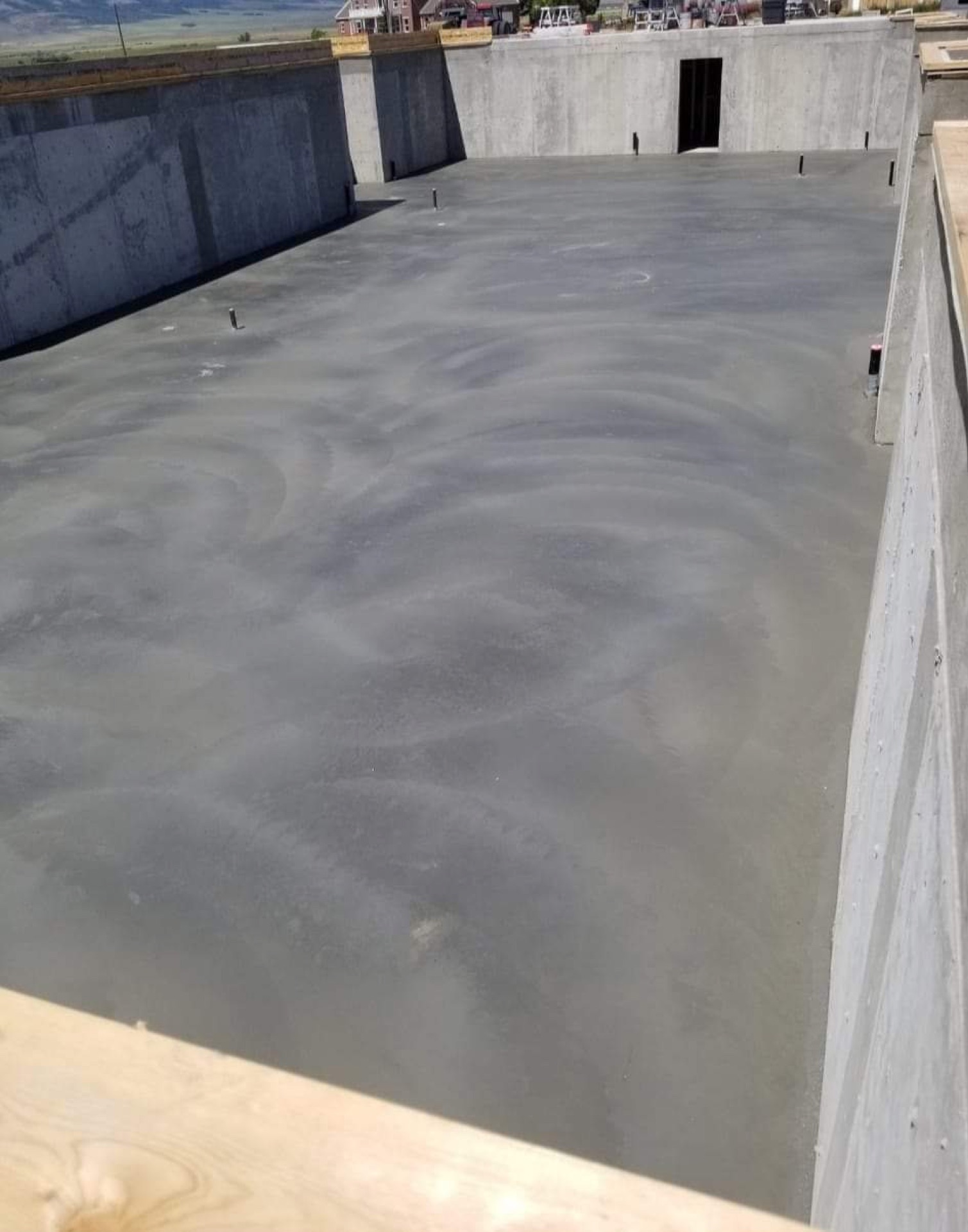
Sooner or later almost every homeowner with a poured basement finds one. A thin line running down the wall behind the water heater, or angling off the corner of a basement window. The first question is always the same: is my foundation failing?
Usually not. I run Skinner Customs out of Rigby and pour foundations across Eastern Idaho. Some cracking in a poured concrete basement wall is normal and expected. A few kinds of cracks are not, and those are worth a closer look. This post walks through how to tell the difference, using the same guidance the concrete industry uses.
Why poured basement walls crack at all
Concrete is at its biggest the day it is poured. As it hardens and dries, it shrinks. It also grows and shrinks with temperature. A basement wall is tied to its footing and buried in soil, so it cannot move freely. When a wall wants to shrink and something holds it in place, it relieves that stress by cracking.
The National Ready Mixed Concrete Association puts it plainly in its bulletin CIP 7, Cracks in Residential Basement Walls:
“Some cracking is normal in concrete basement walls.”
That is why the job is not to promise zero cracks. The job is to control where they happen and how wide they get, and to keep water from coming through.
The common types of basement wall cracks
NRMCA lists the usual suspects. Here is what each looks like when you are standing in your basement with a flashlight.
Shrinkage and temperature cracks. Thin, usually vertical or close to it, often running from the top of the wall partway or all the way down. These are the most common cracks in any poured wall and come from the drying and temperature movement described above.
Re-entrant corner cracks. Diagonal cracks coming off the corners of windows, doors or other openings. NRMCA notes that these “result from shrinkage.” Corners concentrate stress, so the crack starts there.
Pour lines and cold joints. A horizontal line where one load of concrete met the next. NRMCA says pour lines are often perceived as cracks. If the first load had already partly hardened before the second one went in, that line can act like a crack. This is called a cold joint, and it is a workmanship issue.
Form lines. Straight vertical lines where the wall form panels met, sometimes at the form ties. Cracks can start along them.
Restraint cracks. Cracks near the bottom of the wall where the footing holds the wall back from shrinking.
Settlement cracks. NRMCA ties these to non-uniform support of footings or occasionally expansive soils. These are the ones that tend to show up as wider, uneven or stair-stepped cracks, and they are the ones to take seriously.
Backfill cracks. Structural cracks that happen during backfilling when the wall is not strong enough yet or not braced, often when heavy equipment works too close to the wall. Horizontal cracks partway up a wall belong in this group, and they need a professional look.
When a crack is worth worrying about
This is the part most people actually want. NRMCA gives a useful benchmark from how warranties are typically written:
“A typical warranty will require repair only when cracks leak, have measurable vertical displacement, or if the crack width exceeds 1/8-in. (3 mm).”
That gives you three simple checks:
- Is it leaking? Water, dampness, white mineral staining or rust lines along the crack.
- Is one side offset from the other? Run your finger across the crack. If one side sticks out past the other, that is displacement.
- Is it wider than an eighth of an inch? A standard credit card is a lot thinner than that. If a nickel edge slides into the crack easily, it is getting wide.
Add a fourth of my own: is it growing? Mark the ends of the crack with a pencil and write the date next to it. Take a photo with a tape measure across it. Check again in a few months. A crack that holds still through a full winter and spring is a very different animal from one that keeps getting longer or wider. NRMCA’s guidance is to seek professional advice for active cracks that are widening with time.
A thin vertical crack that is dry, flush, and not changing is usually just a shrinkage crack doing what concrete does.
How a basement wall should be built to limit cracking
Most of the bad cracks above trace back to decisions made before and during the pour. NRMCA’s list of construction steps is a good checklist for anyone building a home with a basement in our area.
- Compacted, uniform support. The bulletin says footings must bear on undisturbed soil or well compacted fill, and that soil or fill under the basement should be well compacted by rolling, vibrating or tamping. Uneven support is where settlement cracks come from.
- Reinforcement and wall thickness to code. NRMCA says reinforcement “is used to control crack width” and that wall thickness and steel should follow the International Residential Code, ACI 332 or the local code. Rebar does not stop concrete from shrinking. It keeps the cracks that form tight.
- The right concrete, no extra water. NRMCA says excess water should not be added in the truck mixer and that air-entrained concrete should be used for walls exposed to moisture and freezing temperatures. Every foundation I pour is 4,000 PSI minimum because of our freeze-thaw cycles.
- Continuous placement. Placing in a continuous operation avoids cold joints. That takes planning, enough trucks on schedule and enough crew.
- Curing, and forms left on. NRMCA recommends leaving forms in place 5 to 7 days or at least until the concrete can support itself, and insulating forms with blankets in cold weather. Fall and winter foundation pours in Eastern Idaho need that protection.
- Waterproofing and drainage. Exterior waterproofing, drain tile around the footing, and surface water directed away from the house. NRMCA notes that exterior waterproofing is generally better than interior for keeping water from coming through cracks.
- Careful backfill and grading. Backfill gently, brace the walls or backfill after the floor system is on, and slope the finished grade away from the house. NRMCA calls for a slope of ½ to 1 inch per foot for at least 8 to 10 feet.
That last one is the most common problem I see on homes that are a few years old. The backfill settles, the grade flattens out or tips back toward the house, and water that used to run away now sits against the wall. A crack that was dry for years suddenly leaks.
Fixing a crack
If a crack does need attention, NRMCA lists epoxy injection, dry-packing, and routing and sealing as common repair methods. The bulletin also makes a point people skip: before repairing leaking cracks, check the drainage around the structure and correct it if necessary. Sealing a crack while water keeps pooling outside the wall just moves the leak.
And keep this line from the bulletin in mind: “Cracking is not necessarily a sign of poor materials or workmanship or a structural problem with the concrete wall.”
Frequently Asked Questions
Are cracks in basement walls normal?
Some are. NRMCA says some cracking is normal in concrete basement walls because concrete shrinks as it dries and moves with temperature. Thin, dry, vertical cracks that are not growing are usually shrinkage cracks.
What size basement wall crack is a problem?
A common benchmark is a crack wider than 1/8 inch, a crack where one side is offset from the other, or any crack that leaks. Those are the conditions typical basement warranties treat as needing repair, according to NRMCA.
Are horizontal cracks in a basement wall serious?
They deserve a professional look. Horizontal cracks partway up a wall can come from soil or backfill pressure pushing on the wall. Stair-step, wide or offset cracks also point to movement and should be evaluated.
Why is there a crack at the corner of my basement window?
That is a re-entrant corner crack. NRMCA says these run diagonally from the corners of openings and result from shrinkage. If it is thin, dry and not growing, it is common.
Can a leaking basement crack be fixed from the inside?
Inside repairs like injection can stop many leaks, but fix the outside drainage first. If water keeps pooling against the wall because the grade slopes toward the house or the downspouts dump next to the foundation, the leak tends to come back.
How do I know if a basement crack is getting worse?
Mark both ends with a pencil, write the date, and photograph it with a tape measure across the widest point. Check it every few months. If it gets longer, wider, or one side starts to stick out, have it evaluated.
Building a home with a basement?
If you are planning a foundation in Rigby, Idaho Falls, Rexburg, Ammon or Shelley, or you have a crack in a poured wall and want an honest read on it, call me and I will tell you straight what you are looking at.
Need concrete work in Eastern Idaho? Call Zach at Skinner Customs at (208) 390-5794 or start at skinner-customs.com.
Content produced in partnership with S4 Media, marketing partner of SwagerBuilds LLC.
Leave a Reply