
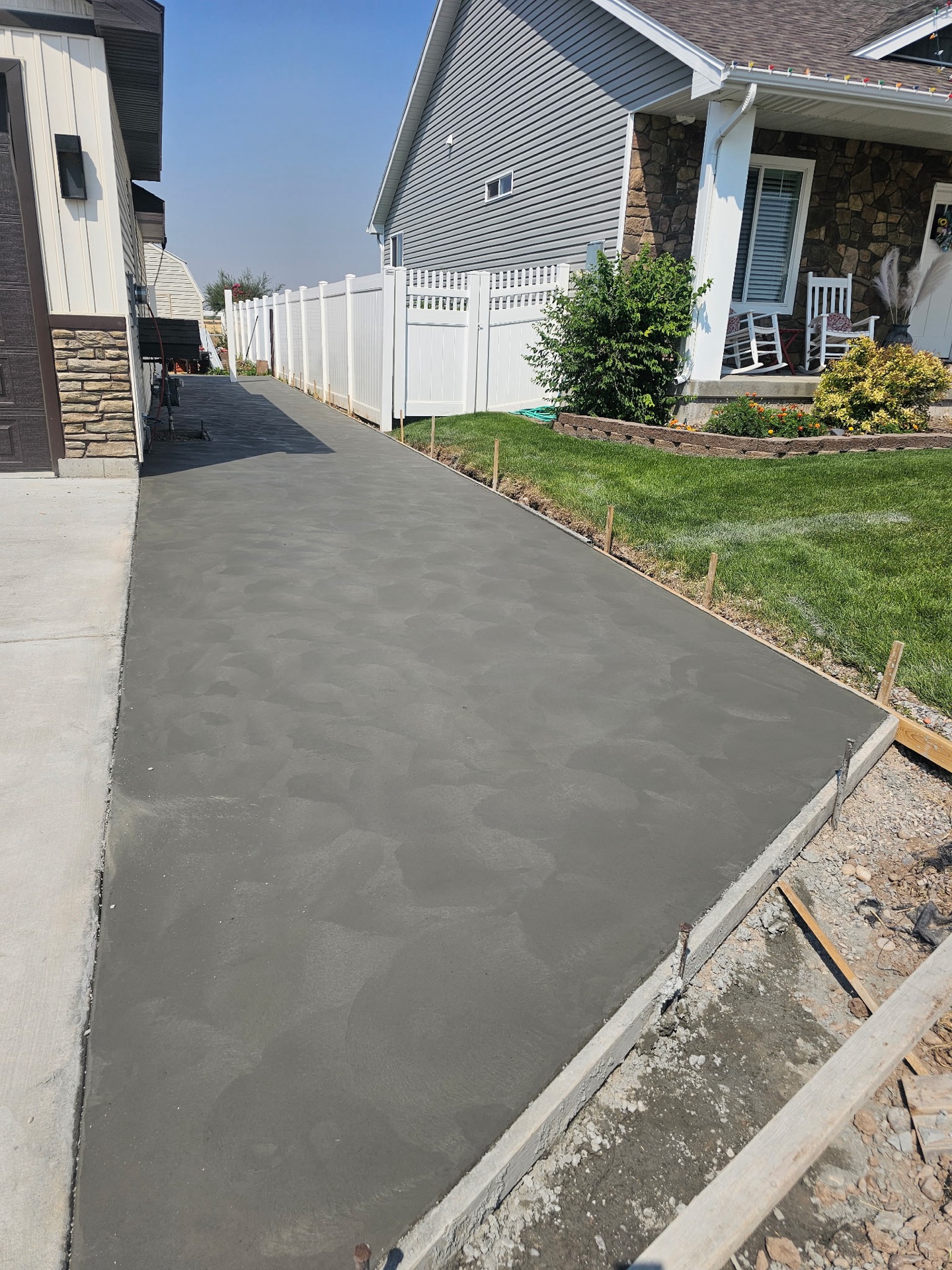
Every spring I get calls about the same thing. A slab that looked perfect in October is coming apart at the surface in April. Not a crack. The top layer is flaking off in sheets and thin chips, the aggregate is starting to show, and the whole thing feels rough underfoot where it used to be smooth.
That is scaling, and it is almost always an air problem.
I run Skinner Customs out of Rigby, and air entrainment is the one spec on a concrete order that nobody asks about and everybody should. It does not show up in a bid. You cannot see it in the finished slab. You find out whether it was right about five months after the truck leaves.
Here is what it is, what the code actually requires in our part of Idaho, and the three ways it gets lost between the batch plant and the broom.
What air entrainment actually is
Air-entrained concrete has microscopic air bubbles mixed into it on purpose. An admixture goes in at the batch plant and creates billions of tiny voids spread evenly through the paste.
They are there for one reason. Water expands about nine percent when it freezes. Concrete is porous, so it holds water, and when that water freezes inside a slab with nowhere to go, it pushes. Repeat that a few dozen times and the paste at the surface loses its grip on the aggregate.
The bubbles give that water somewhere to go. They work like expansion tanks inside the concrete. Freeze the slab and the ice pushes into the nearest void instead of into the paste holding everything together.
This is not the same thing as air that got trapped by sloppy placement. Those are big, irregular voids, and they are a defect. Entrained air is small, deliberate, and measured.
In Eastern Idaho we do not get one freeze. Rigby, Idaho Falls, Rexburg, Ammon and Shelley all run through dozens of freeze and thaw cycles between November and April, and the worst ones are the spring days that hit the forties in the afternoon and drop into the twenties overnight. That cycle is what takes slabs apart, and it is why this spec matters more here than it does in Boise or Phoenix.
What the code requires here
This is not a preference. It is written into the residential code Idaho adopted.
The 2018 International Residential Code, Section R402.2, Concrete, says: “Concrete subject to moderate or severe weathering as indicated in Table R301.2(1) shall be air entrained as specified in Table R402.2.”
The map the code points to for that weathering column, Figure R301.2(4), puts our part of Idaho in the severe category. That is the worst of the three.
Then Table R402.2 sets the number. Footnote d reads: “Concrete shall be air-entrained. Total air content (percent by volume of concrete) shall be not less than 5 percent or more than 7 percent.”
Five to seven percent. There is a ceiling on it as well as a floor, and that matters, because air costs you strength. Too little and the slab scales. Too much and you have given away compressive strength for protection you did not need.
The same table sets minimum strength by where the concrete goes. For porches, carport slabs, steps exposed to the weather and garage floor slabs in a severe weathering area, the code floor is 3,500 PSI.
Why I order 4,000 PSI when code says 3,500
Because 3,500 is a minimum, and minimums are written for the whole country.
My standard on flatwork is 4,000 PSI. Our winters are harder on a weak mix than the code floor assumes, and the surface is where you see it first. The difference in concrete cost between those two numbers on a residential driveway is small. The difference five winters later is not.
There is also a specific case in the code where the two numbers trade against each other. Footnote f allows a garage floor with a steel-troweled finish to drop total air content to as low as 3 percent, but only “if the specified compressive strength of the concrete is increased to not less than 4,000 psi.” That exception exists because hard troweling and high air do not get along, which brings up the next part.
The three ways air gets lost on a job site
The batch plant can deliver a perfect 6 percent mix and the slab can still scale. Here is where it goes wrong.
1. Water added at the truck. Concrete that sits too long gets stiff and hard to place. The fast fix is water in the drum, and it is the most common thing I see on other crews’ pours. It makes the concrete easier to move and it wrecks the mix. More water means lower strength, a weaker paste at the surface, and air content that no longer matches the ticket. If the pour needs to be workable, that gets handled at the plant with the mix design, not with a hose on site.
2. Over-finishing. Working the surface too much, too hard, or too early drives the entrained air out of the top layer, which is exactly the layer that has to survive winter. A hard steel trowel finish on exterior concrete also seals the surface while bleed water is still trying to get out, and that water comes back as blisters and delamination. The top eighth of an inch lets go in sheets.
3. Finishing too early. Starting before the bleed water is gone works that water back into the surface. You end up with a thin, weak, water-rich layer sitting on good concrete. It looks fine for one season.
Two and three are why exterior flatwork gets a broom finish, which is my standard. A broom finish is not a cheaper finish. It leaves the surface texture open, it does not trap bleed water, and it gives you traction on a driveway that is going to be icy four months a year. The slick troweled look belongs on an interior slab that will be covered.
Deicing salt makes all of this worse
Salt and ice melt do not attack concrete chemically the way people assume. What they do is pull more water into the surface and increase how many times it cycles through freezing. You are running the same destructive process more often and with more water in it.
On concrete with the right air content and the right strength, that is survivable. On a low-air, over-finished, water-added slab, deicer is what finishes the job. If a slab is in its first winter, stay off the deicer entirely and use sand for traction.
What to ask for
Two things, and both are reasonable to ask of any contractor.
- The mix spec in writing. PSI and air content, on the bid or the contract. You want to see a number, not the word “standard.”
- The batch ticket. Every ready-mix load comes with one. It lists the mix design that was delivered. Ask for a copy. A contractor who does not want you to have it is telling you something.
My floor on flatwork is eight dollars a square foot and it goes up from there with thickness, access and finish. I publish that number because when a bid comes in under it, the money came out of somewhere: a thinner slab, wire mesh instead of rebar, less base prep, or a weaker mix. The mix is the one you cannot see.
Frequently asked questions
How do I know if my concrete was air-entrained?
Ask for the batch ticket from the ready-mix supplier. It lists the mix that was delivered. After the fact, on a finished slab, you cannot tell by looking, and the first real evidence is usually scaling after a winter or two.
Does air-entrained concrete make a slab weaker?
Entrained air does trade some compressive strength, which is why the code caps it at 7 percent instead of asking for as much as possible. Specified correctly, the freeze-thaw protection is worth far more than the strength given up. That is also why I order 4,000 PSI rather than the code minimum.
Is scaling the same thing as cracking?
No, and they have different causes. Cracking is movement, and joints and rebar control it. Scaling is the surface paste losing its grip and flaking off, and that is a mix and finishing problem. A slab can scale without a single crack in it.
Can a scaled slab be fixed?
Sometimes, and it depends on how deep it goes. Surface scaling on otherwise sound concrete can be resurfaced. Once it is deep enough that aggregate is loose and the slab is losing thickness, you are looking at replacement, because the layer that was supposed to protect it is gone.
Does interior concrete need air entrainment?
Generally no. An interior slab that will never freeze does not need it, and leaving it out keeps the strength. The code ties the requirement to weather exposure for that reason.
Why does my neighbor’s driveway look fine and mine is flaking?
Same winter, different slab. Air content, strength, how hard the surface was finished, whether water went in at the truck, and whether deicer got used in the first season. Any one of those can be the difference.
Ask about the mix before the truck is ordered
Reinforcement, thickness and base prep all get discussed because people can picture them. The mix is invisible and it is the one that decides what your slab looks like in five years.
If you are taking concrete bids in Rigby, Idaho Falls, Rexburg, Ammon or Shelley, ask every bidder for PSI and air content in writing, and ask for the batch ticket when the concrete shows up.
Need concrete work in Eastern Idaho? Call Zach at Skinner Customs at (208) 390-5794 or start at skinner-customs.com.
Content produced in partnership with S4 Media, marketing partner of SwagerBuilds LLC.
Leave a Reply