
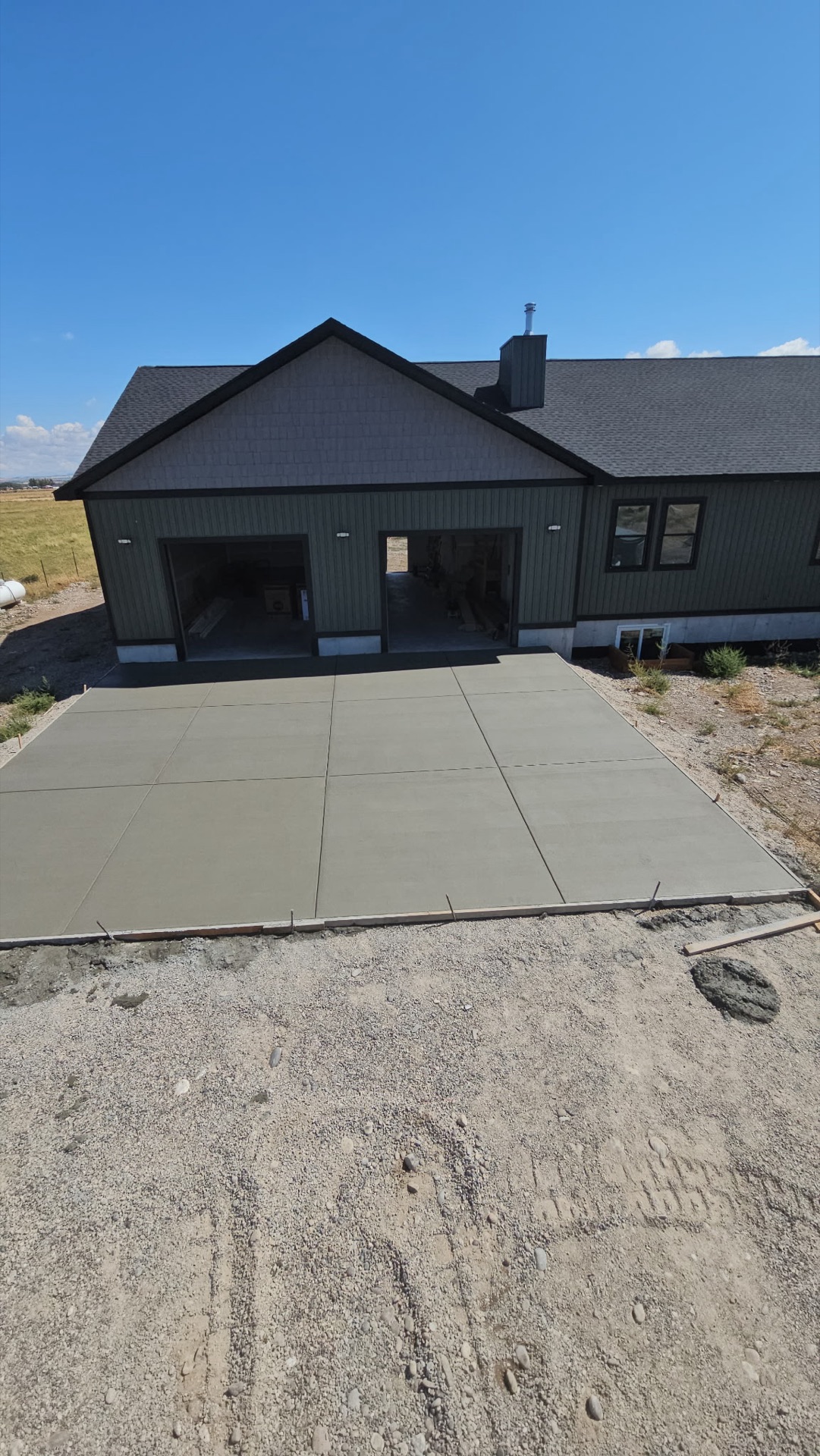
Weight is not what kills concrete driveways in Eastern Idaho. Water is. A 4-inch slab on a compacted base will carry a loaded pickup for forty years. That same slab, poured flat so water sits on it or runs back toward the house, will be spalling at the surface and heaving at the joints in five.
I run Skinner Customs out of Rigby and I pour driveways from Rexburg down to Shelley. Slope is the cheapest insurance on the whole job. It costs nothing but attention at grade stake time, and it is the single thing I see skipped most often on driveways that come back to bite somebody.
Here is the number, where it comes from, and what it actually looks like on a real driveway.
The number: 2 percent, which is a quarter inch per foot
This is in the code, and it is not vague. The 2018 IRC as adopted in Idaho, section R401.3 Drainage, says:
“Lots shall be graded to drain surface water away from foundation walls. The grade shall fall not fewer than 6 inches (152 mm) within the first 10 feet (3048 mm).”
And then, specifically about concrete and asphalt:
“Impervious surfaces within 10 feet (3048 mm) of the building foundation shall be sloped not less than 2 percent away from the building.”
Two percent is a quarter inch of drop per foot of run. On a 24-foot driveway from the garage door to the street, that is 6 inches of fall. On a 60-foot approach it is 15 inches. Write those down before you pour anything, because that is the difference between a driveway that drains and one that ponds.
A quarter inch per foot does not look like anything when you are standing on it. You cannot feel it walking, you will not feel it in a vehicle, and it does not read as a hill in photographs. Homeowners worry about this and they should not. What you will notice is the opposite: a driveway with no fall on it reads instantly after the first rain, because the water is still there an hour later.
Why it matters more here than in a mild climate
A flat slab in a dry, warm climate is a cosmetic problem. A flat slab in Jefferson, Bonneville or Madison County is a durability problem, for three reasons.
Freeze-thaw. Standing water soaks into the top of the slab, freezes overnight, expands and pushes the surface paste apart. Do that across a few dozen cycles every late fall and spring and you get spalling, which is the surface flaking off in sheets and leaving exposed aggregate. Concrete that drains stays dry long enough to survive those cycles.
Snowmelt instead of rain. Rain is a one-hour event. A snowbank sitting on a driveway panel for a week in February is a continuous water source, melting through the warm part of the day and refreezing every night. Every low spot becomes a reservoir, and the panels around a low spot are the first to go.
De-icing salt. Water that drains carries the chlorides off the slab. Water that sits concentrates them. If you treat a driveway that holds water, you are soaking the concrete in brine, and new concrete is the most vulnerable to that.
That is also why I pour 4,000 PSI minimum here and will not go below it. A high-strength, properly air-entrained mix plus real slope is what gets a driveway through twenty Idaho winters. One without the other is a coin flip.
Where the water is supposed to go
Slope is a direction, not just a number. Getting the fall right and aiming it somewhere wrong is still a failed driveway.
- Away from the house, always. That is what R401.3 is about. The garage slab and the apron in front of it have to shed water out and away, never back toward the foundation or into the garage.
- To the street, a swale or a drain. On most town lots in Rigby and Idaho Falls, the natural answer is the street or the gutter, following the existing grade. On rural lots with no curb, it is usually a swale along one side.
- Not onto the neighbor and not into the field. Dumping your runoff across a property line creates a problem you will hear about. If the lot does not give you a clean route, that gets designed before the pour, not discovered after.
- Not into a low spot in the lawn next to the slab. Water that pools against the edge of a driveway soaks the base under the edge, and a saturated base is a settling base.
R401.3 allows for lots where the grade cannot be made to work: “Where lot lines, walls, slopes or other physical barriers prohibit 6 inches (152 mm) of fall within 10 feet (3048 mm), drains or swales shall be constructed to ensure drainage away from the structure.” That is the honest answer on a tight lot or a benched hillside. It means a drain or a swale, engineered on purpose, not a flat slab and a shrug.
The garage threshold, where most of the damage happens
The worst callbacks I see are not out in the middle of the driveway. They are the first four feet in front of the garage door.
That spot takes everything. Snow falls off the vehicle and off the roofline and piles up right there. The apron is usually the lowest point of the driveway if the slope was set carelessly, because people think about draining the long run and forget the transition at the top. And the door threshold is the one place where standing water has somewhere worse to go, which is under the door and onto the garage slab.
So the apron gets fall away from the door, the same quarter inch per foot minimum, and the top of the driveway sits below the garage slab, not level with it. On a flat site that sometimes means the whole approach gets set a little lower than the homeowner expected. That is a deliberate choice, and it is the right one.
What slope cannot fix
Slope controls where water goes. It does nothing about what is underneath the slab.
If the base was not compacted, if the fill went in one lift instead of several, if a utility trench crossing the driveway was backfilled loose, the slab settles and your perfect quarter inch per foot becomes a birdbath. I have torn out driveways that were graded correctly on day one and were holding water two years later because the base was never right.
That is why base prep is the first half of my job and finishing is the last: minimum 4 inches of compacted gravel, placed in lifts on questionable soils, before any steel goes down. And the steel is rebar, number three or number four on an 18-inch grid. Rebar does not stop a crack, but it holds the two sides of one at the same elevation, which keeps a crack from turning into a lip that catches water. Wire mesh does not do that job, because it gets walked flat during the pour and ends up at the bottom of the slab doing nothing.
What to ask before you sign
Three questions, and the answers tell you a lot about who you are hiring.
- How much fall does my driveway have, and in what direction? You want a number in inches and a direction, not “it will drain.” A contractor who has walked the site can tell you both.
- Where does the water end up? Street, swale, drain, or a plan for the tight-lot exception in the code. If nobody can answer this, nobody has thought about it.
- How is the apron set relative to the garage slab? You are listening for the driveway sitting below the garage, with fall away from the door.
Frequently asked questions
Will I notice a 2 percent slope on my driveway?
No. A quarter inch per foot is not perceptible underfoot or in a vehicle, and it does not show in photos. What you notice is water that is gone twenty minutes after it stops raining.
Is more slope better?
Up to a point. More fall drains faster, and on a long rural approach I will often run more than the minimum because it helps with snowmelt. Past roughly 10 percent you start getting into traction problems on ice and scraping on low vehicles, so it is a balance, not a maximum.
My driveway is flat and already poured. What are my options?
Depends on why. If the slab is sound and the problem is one low panel, saw-cutting and replacing that panel can be the fix. If the whole run was poured flat, there is no resurfacing product that creates real drainage over a large area without creating new problems at the edges. Have somebody look at it on site before spending money, because the answer is different for a birdbath than for a flat driveway.
Does the slope requirement apply to patios and sidewalks too?
Yes. The code language is about impervious surfaces near the foundation, so a patio against the back of the house falls under the same 2 percent rule. Walks get the same treatment for the same reason.
What about a driveway that has to run downhill toward the garage?
That happens on hillside lots and it needs a real drainage design: a trench drain across the apron, tied into something that takes the water away, plus the swale or drain the code exception calls for. It is more expensive than a normal approach and it is not optional on that kind of site.
Get the grade answer before the forms go in
If you are collecting driveway bids in Rigby, Idaho Falls, Rexburg, Ammon or Shelley, ask every bidder how much fall your driveway gets and where the water goes. The number is a quarter inch per foot minimum and it is in the code, so anybody who cannot give you an answer is telling you something.
Need concrete work in Eastern Idaho? Call Zach at Skinner Customs at (208) 390-5794 or start at skinner-customs.com.
Content produced in partnership with S4 Media, marketing partner of SwagerBuilds LLC.
Leave a Reply