The first real storm of the year rolls through and every hardware store in Idaho Falls sells out of ice melt by Saturday afternoon. A lot of that ice melt ends up on driveways that are going to look rough by April.
Not because ice melt is poison. Because of how much goes down, when it goes down, and what kind of concrete it lands on.
I run Skinner Customs out of Rigby, and the question I get every November is some version of “can I salt my driveway?” The short answer is yes, on the right slab, in the right amount. The long answer is below, because the wrong answer costs you a surface you cannot get back.
What ice melt actually does to concrete
Most people picture salt eating the concrete like acid. That is not usually what happens. The damage is mostly physical, and it comes from water.
Concrete is porous. It soaks up water, and when that water freezes it expands and pushes against the paste around it. The National Ready Mixed Concrete Association lays the mechanism out in its bulletin CIP 2, Scaling Concrete Surfaces:
“When concrete is saturated with water and temperature approaches freezing, water expands as it forms ice and this causes stresses within concrete. As the number of cycles of freezing and thawing increases, the potential for scaling increases.”
Then the part that matters for this post:
“Deicing chemicals exacerbate this by increasing the saturation of concrete at the surface and the number of freezing and thawing cycles.”
Think about what ice melt does. It turns ice into water on a slab that is sitting right around freezing. That water soaks into the top of the concrete. The sun goes down, it refreezes. The next morning you throw more ice melt on it. Our part of Idaho already gives a slab plenty of freeze-thaw cycles every winter. Heavy de-icing adds more of them, right at the surface, in the wettest part of the slab.
That is how you get scaling: the top layer flaking off in chips and sheets until the rock starts showing through.
The first-winter rule
This is the one I hold every customer to. A slab poured this year does not get any de-icing chemical this winter. Not rock salt, not the blue pellets, not the pet-safe bag. Sand for traction instead.
NRMCA puts it in plain words in its list of rules to prevent scaling:
“Avoid the use of deicing chemicals in the first winter and subsequently use them in moderate amounts.”
The reason is in the same bulletin. Among the most common causes of scaling it lists the “application of excessive amounts of deicing chemicals, especially on newly installed concrete that tends to be saturated and of lower strength.”
New concrete keeps gaining strength for months after the pour, and it is still holding a lot of its original water. A late-summer or fall slab going into its first Eastern Idaho winter is the most vulnerable it will ever be. One season of sand is cheap insurance on a slab that should last decades.
If we poured your driveway, patio or walk this year, the rule is sand only through spring.
After the first winter: moderate, not zero
Once a slab has a full year behind it and was built right, you can use ice melt. The word NRMCA uses is moderate, and that is the right word.
Here is what moderate looks like on a driveway:
- Shovel first, melt second. Ice melt is for the thin layer you cannot scrape off, not a substitute for the shovel. Every inch of snow you melt instead of moving is water you just put into your slab.
- Scatter it, do not pile it. You want granules spread out with bare concrete between them, not a white crust. Read the bag and stay at or below its coverage rate.
- Clear the slush. Once it has done its job, push the brine off the slab. Brine left sitting overnight is the refreeze that does the damage.
- Keep it off decorative work. Stamped, colored and exposed aggregate surfaces have the most to lose. Sand those.
- Watch what drips off the truck. Road brine and salt slush off the wheel wells land in the same spot in your garage and on your apron every night. Rinse those spots on a warm afternoon.
- Never use fertilizer as ice melt. Some people grab a bag of fertilizer because it melts ice too. Ammonium-based products are hard on concrete. Use a product sold as ice melt and read the label.
The bigger factor is how the slab was built
You can do everything above right and still lose the surface if the concrete was wrong from the start. NRMCA’s list of what causes scaling starts with the mix and the work, not the homeowner:
- Non-air-entrained concrete, or too little entrained air, especially at the surface
- Low-strength concrete that lets water in
- The wrong mix for the job
- Too much de-icer, especially on new concrete
- Improper finishing
- Insufficient curing
Only one of those six is on you. The rest were decided before the slab ever saw snow.
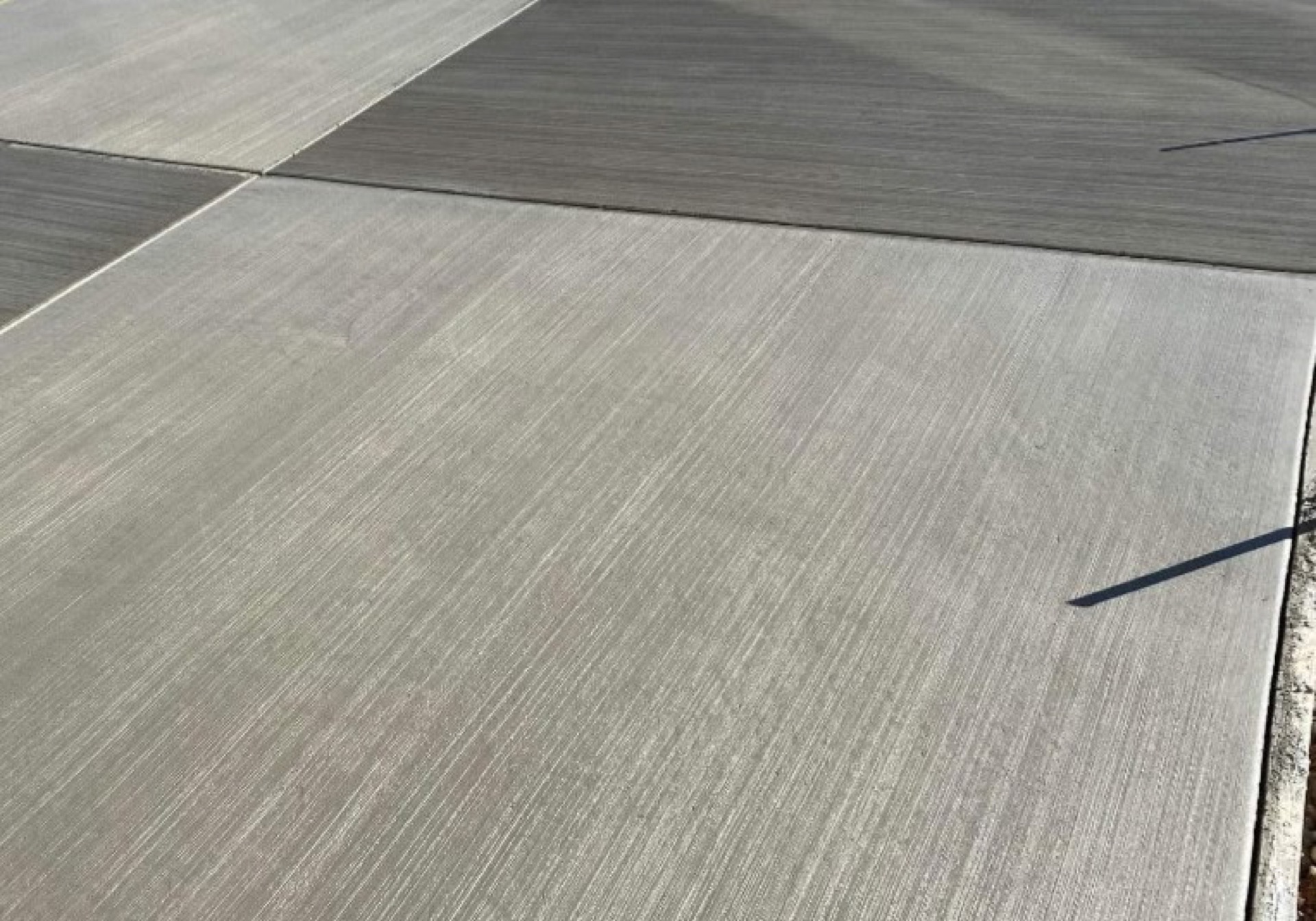
For concrete that will see freezing and de-icers, the bulletin calls for exterior slabs ordered at “specified strength of 4000 psi” and air-entrained concrete with a total air content of 6 percent for the common coarse aggregate sizes. That lines up with how I pour. Every exterior slab I place is 4,000 PSI minimum because of our freeze-thaw cycles, on a compacted gravel base, reinforced with rebar, broom finished, and properly cured.
If you are getting bids for a driveway next year, ask every contractor what strength and air content they are ordering. If they cannot answer, that tells you something.
What scaling looks like, and when to call
NRMCA describes three levels. Light scaling does not expose the coarse aggregate. Moderate scaling exposes the aggregate and may involve “loss of up to ⅛ to ⅜ inch” of the surface mortar. Severe scaling leaves the aggregate clearly exposed and standing out.
Light scaling is mostly cosmetic. If it is spreading year over year, or the rock is standing proud of the surface, the bulletin notes that light to moderate scaling can be repaired with a thin bonded resurfacing once the unsound surface is removed, and that repairing slabs with excessive and progressing scaling “may not be feasible.” Repair material also will not match the color of the original concrete.
The cheapest fix is the one you never need. Shovel more, melt less, and keep chemicals off a new slab.
Frequently Asked Questions
Is ice melt bad for concrete?
Used heavily, especially on new concrete, yes. It does not usually eat the concrete. It makes the surface wetter and adds freeze-thaw cycles, which is what causes scaling. Used in moderate amounts on a well-built slab that has been through its first winter, it is fine.
Can I use rock salt on a driveway poured this year?
No. Skip all de-icing chemicals the first winter and use sand for traction. NRMCA recommends avoiding deicers in the first winter because new concrete is still saturated and has not reached full strength.
Is pet-safe ice melt safe for new concrete?
It is safer for paws, not for a new slab. It still turns ice into water on the surface, and that water is what does the damage. Sand the first winter.
Should I seal my driveway before winter?
A breathable sealer is on NRMCA’s list of ways to help prevent scaling. Penetrating sealers need warm, dry conditions to cure, and here that window usually closes in October. If you missed it, plan to seal in the spring and go light on de-icers until then.
What is the safest way to deal with ice on concrete?
Shovel early and often, use sand for traction, and use ice melt only for the thin layer you cannot scrape off. Push the slush off once it melts so it cannot refreeze on the slab overnight.
My driveway is already flaking. Can it be fixed?
Light to moderate scaling can often be repaired with a thin bonded resurfacing once the loose surface is removed. Severe or spreading scaling may mean the slab or some panels need replacing. Send me photos and I will tell you which one you are looking at.
Worried about your slab this winter?
If you have a driveway, patio or walk in Rigby, Idaho Falls, Rexburg, Ammon or Shelley that is starting to flake, or you are planning a pour for next season, call me and I will tell you straight what you are looking at.
Need concrete work in Eastern Idaho? Call Zach at Skinner Customs at (208) 390-5794 or start at skinner-customs.com.
Content produced in partnership with S4 Media, marketing partner of SwagerBuilds LLC.
Leave a Reply