
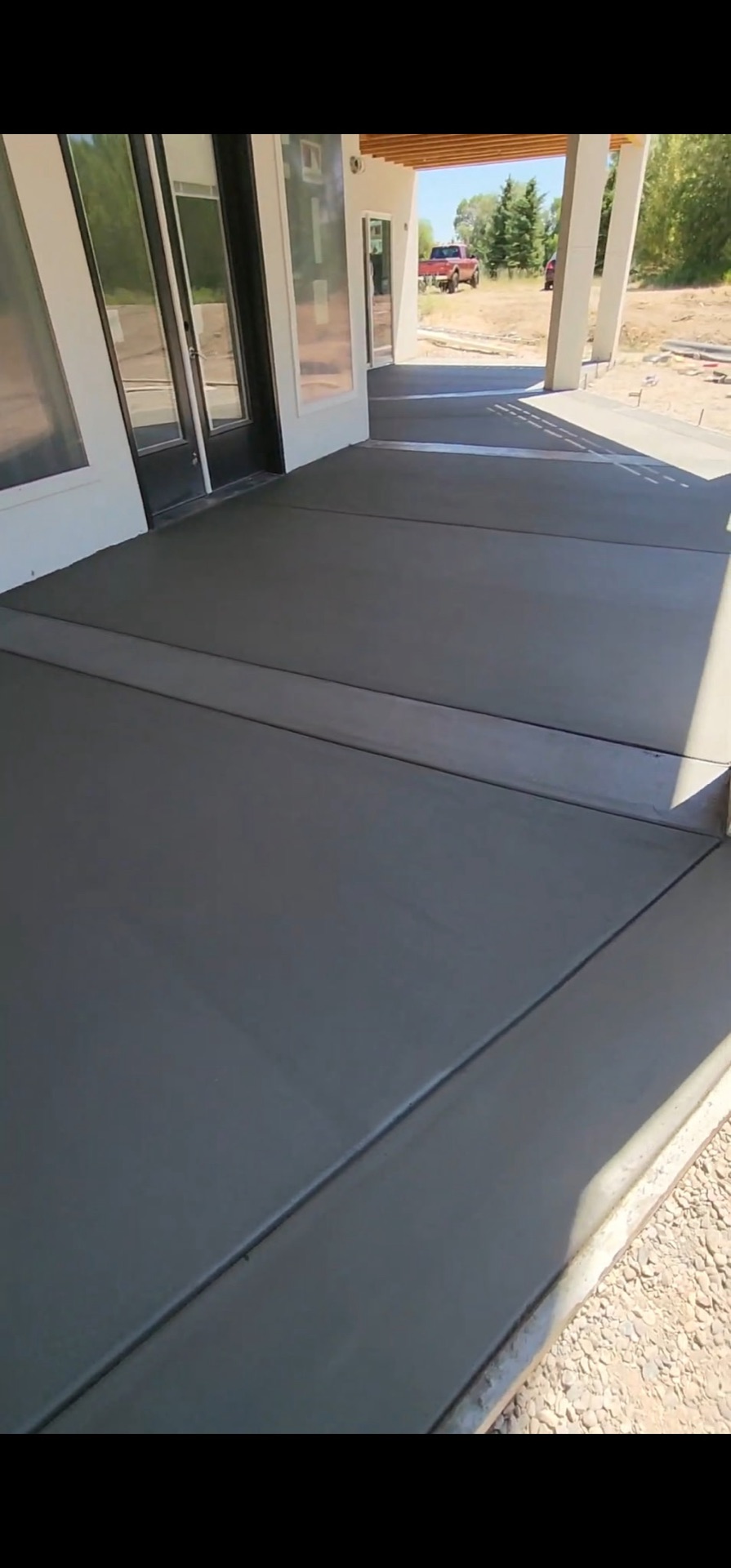
I run Skinner Customs out of Rigby, and the call I get most often between March and May starts the same way: the concrete made it through another winter and now it looks worse than it did in the fall.
Usually the question that follows is what the repair is going to run. I am not going to publish a repair price in this post, and here is why. Repair cost is not a number per square foot the way a new pour is. Two driveways with the same cracks can be a quick afternoon on one house and a tear-out on the next, and the thing that decides which one you have is what is under the slab, not what you can see on top of it.
So instead of a fake number, here is how I read a failing slab, what actually moves the price, and when I tell people not to spend money on a repair at all.
The three ways concrete fails around here
Almost everything I get called out to look at falls into one of three buckets.
Cracks. Concrete cracks. That is not a sales dodge, it is the material. The American Concrete Institute treats some cracking as expected in normal work, which is why the industry designs where cracks go instead of pretending they will not happen. A tight crack that runs through a control joint, or a hairline that has not moved in two years, is usually cosmetic. A crack you can set a pencil in, one with a lip you can feel with your boot, or one that keeps opening season over season is telling you something underneath moved.
Spalling. That is the surface flaking, popping or scaling off, often in sheets or dime-sized craters. This is our climate doing exactly what our climate does. Water gets into the top layer, freezes, expands and pushes concrete off from the inside. Spalling shows up worst where salt and snowmelt sit: garage aprons, the first few feet of driveway, steps, sidewalk edges along the street.
Sinking and heaving. One section drops, or one section lifts, and now you have a trip edge between two panels. Sinking means the dirt under the slab settled or washed out. Heaving means frost got under it and lifted it. Around Rigby and out through Jefferson County, irrigation water and canal season give us more washout than people expect.
Which of those is actually a base problem
Here is the short version I give people standing in the driveway.
Spalling is a surface and mix problem. Cracks can be either. Sinking and heaving are always a base problem.
That matters because repairing the surface of a slab whose base failed is throwing money away. You can grind, patch, resurface and seal a panel that is sitting on a void, and the void does not care. It will show back up the next spring, and now you have paid twice.
The code language on base prep is specific. The 2018 IRC as adopted in Idaho says at R506.2.2:
“A 4-inch-thick (102 mm) base course consisting of clean graded sand, gravel, crushed stone, crushed concrete or crushed blast-furnace slag passing a 2-inch (51 mm) sieve shall be placed on the prepared subgrade where the slab is below grade.”
Four inches of clean, compacted base. That is the floor, not the goal. On questionable soil, and we have plenty of it in this valley, I build it up in lifts and compact each one. When I tear out a failed slab and find three inches of dirt-contaminated gravel that was never compacted, I already know why I am standing there.
What actually drives the cost of fixing it
When I price concrete work on a repair call, these are the things that move the number.
How much has to come out. Concrete is cheap compared to labor and haul-off. Breaking out, loading and hauling an old slab is real work, and a panel against a house, a fence line or a finished landscape is slower than one sitting in the open.
Access. If a truck can back up to it and chute directly, that is one price. If we are wheeling it in with buggies or pumping it, that is another. A backyard patio behind a narrow gate costs more than a front driveway every time.
Thickness and what it carries. A four-inch walk is not a six-inch driveway apron with a trailer parked on it. Thicker means more concrete, more base work and more steel.
Steel. We use rebar, number three or number four on an eighteen-inch grid. Not wire mesh. Mesh gets walked on during the pour, lifts out of position, and you end up with steel sitting at the bottom of the slab doing nothing where the cracks form. If somebody is cheaper than me and the plan says mesh, that is part of why.
Mix. Four thousand PSI minimum for our freeze-thaw cycles. A weaker mix saves a few dollars a yard and buys you the spalling conversation in five years.
Matching what is already there. Patching into colored or stamped concrete is the hardest thing on this list. Color cures differently at different ages, so a patch on a ten-year-old stained patio will never be invisible. Sometimes the honest answer is replacing a whole panel so the seam lands at a joint instead of in the middle of a field.
Mobilization. A small repair carries the same trip, the same crew showing up and the same minimum as a bigger one. That is why one cracked panel often prices out closer to a whole driveway than people expect, and why bundling repairs into one visit is cheaper than three calls across two years.
When I tell people not to repair
I will say this plainly even though it costs me work sometimes.
If the slab is sitting on a failed base, if it is already thin, if it was poured on mesh and is cracked in more than one direction, or if more than about a third of it is bad, patching is a payment plan on the same problem. Tear it out and pour it right once.
My floor on new flatwork is eight dollars a square foot, and it goes up from there with thickness, access and finish. I publish that number because anybody quoting you under it is taking it out of somewhere you cannot see: a thinner slab, mesh instead of rebar, skipped compaction, or a weaker mix. When a repair starts creeping toward replacement money, you are better off putting it toward concrete that starts over with the base.
One more thing I will not sell you. Lifting a sunken slab with foam or mud is a specialty rig and it is not what I do, so if that is genuinely your best option I will tell you that and you should call an outfit that does it all day. What I will not do is skim-coat over a heaving panel, pretend an overlay fixes a structural crack, or saw-cut new loops into a slab and call it a repair.
Frequently asked questions
Is a crack in my driveway a problem or just cosmetic?
Check three things: width, whether it has a vertical lip, and whether it has grown. Tight, flat and stable is usually cosmetic and can be sealed. Wide, lipped or growing means something moved underneath and sealing it just hides it.
Why is my concrete flaking off in sheets?
That is spalling, and in our climate it is almost always freeze-thaw damage made worse by de-icing salt, a weak surface, or water that was overworked into the finish. Sealing good concrete prevents it. Sealing already spalling concrete does not reverse it.
Can you just patch one section of my driveway?
Sometimes, and the seam will show. The better version is replacing full panels so the new edges land on existing joints. On colored or stamped work, expect a visible difference no matter who does it.
How long should a concrete driveway last in Eastern Idaho?
Built right, with compacted base, rebar and a four thousand PSI mix, decades. Built on mesh and uncompacted fill, you can be looking at cracks inside five years. Nearly every short-lived slab I tear out failed from the bottom up, not the top down.
Is it cheaper to repair or replace?
Repair wins when the damage is isolated, the base is sound and the slab has thickness left. Replacement wins when the base failed, the slab is thin, or the bad area is a third or more of the surface. Anybody who answers that without looking under the slab is guessing.
Get somebody to look at it before you spend money
If you have concrete going bad in Rigby, Idaho Falls, Rexburg, Ammon or Shelley, have it looked at before you buy a repair. Half the calls I go on end with me telling the homeowner their slab has years left and all it needs is a joint cleaned out and sealed.
Need concrete work in Eastern Idaho? Call Zach at Skinner Customs at (208) 390-5794 or start at skinner-customs.com.
Content produced in partnership with S4 Media, marketing partner of SwagerBuilds LLC.
Leave a Reply