
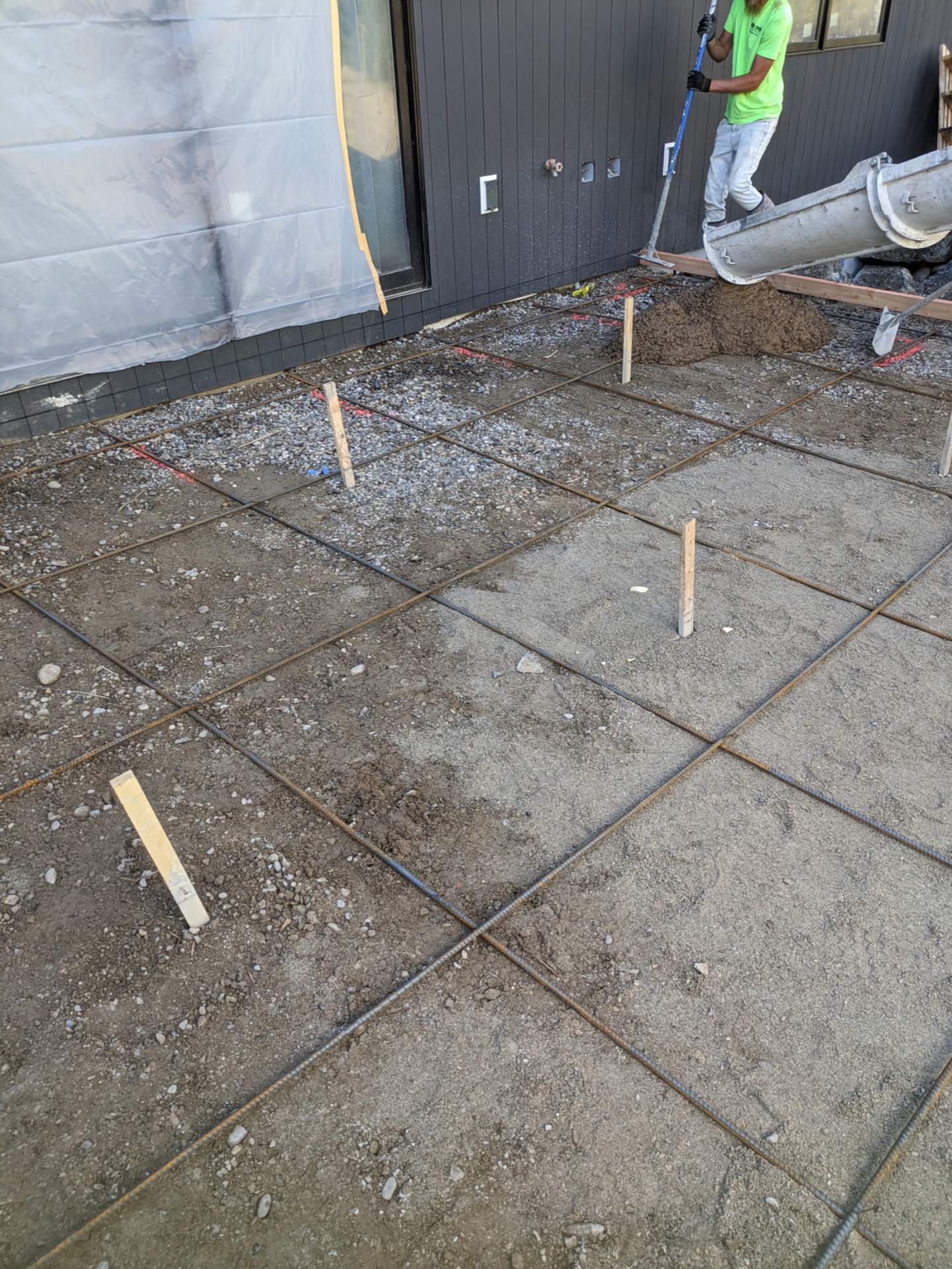
Rebar vs wire mesh is the line item most homeowners skip right past when they are comparing concrete bids, and it is the one that explains most of the price gap. Two bids on the same driveway, same square footage, same four inches of concrete, and one is noticeably cheaper. Nine times out of ten the cheap one has mesh in it.
I run Skinner Customs out of Rigby. I pour rebar, number three or number four on an 18-inch grid, on everything. Not because it sounds better in a bid, but because I am the one who gets called back in five years to look at the result, and I have torn out enough mesh slabs around Idaho Falls and Rexburg to know how that movie ends.
Here is what each one actually does, what happens to mesh during a real pour, and what the code in Idaho has to say about it.
Neither one stops concrete from cracking
Start here, because this is where most of the confusion comes from. Steel in a slab is not crack prevention. Concrete shrinks as it cures and keeps moving with temperature and moisture, and it will relieve that tension somewhere. Joints decide where. Steel decides what the crack does after it forms.
The National Ready Mixed Concrete Association says it directly in CIP 6, Joints in Concrete Slabs on Grade: “Note that wire mesh will not prevent cracking. Mesh tends to keep the cracks and joints from opening up.”
That is the honest job description for mesh. It is a crack-width manager. Rebar, placed properly and sized for the slab, does more. It keeps the two sides of a crack in the same plane, it carries load across that crack, and it holds panels together when the ground underneath is not perfectly uniform, which in our part of the state it never is.
So when somebody tells you their mesh slab “won’t crack,” that is not a specification, that is a sales line.
What happens to mesh during an actual pour
This is the part that does not show up in a bid comparison.
Mesh comes in rolls or flat sheets and it has to sit at a specific height inside the slab to do anything at all. On a 4-inch slab that means roughly the middle to upper third of the thickness. The problem is that mesh is light, it springs, and a concrete pour is a job site with people and wheelbarrows and boots on it.
Crews walk the mesh flat. The concrete truck chute hits it. Somebody drags a rake across it. By the time the slab is screeded, a lot of that mesh is lying on the gravel at the bottom of the pour, which is the one place it does nothing, because the tension that opens a shrinkage crack is in the top of the slab.
The Idaho-adopted 2018 International Residential Code addresses exactly this. Section R506.2.4, Reinforcement Support, reads: “Where provided in slabs-on-ground, reinforcement shall be supported to remain in place from the center to upper one-third of the slab for the duration of the concrete placement.”
Read the last six words again. For the duration of the concrete placement. Not when it was laid out that morning. Not in the photo the contractor took before the truck arrived. During the pour and at the end of it. Mesh that has been stepped flat does not meet that, and pulling it up with a hook as the concrete goes in is a technique people talk about more than they do.
Rebar on chairs stays where it was set. It is stiff enough to walk on without collapsing, it ties into a grid that holds its shape, and it is still at the right height when the screed goes across.
How I build a slab here
Nothing exotic, and I will put it in writing because it is the same on every job:
- Base. Minimum 4 inches of compacted gravel, placed in multiple lifts where the soil is questionable. Most slab failures I tear out started here, not with the steel.
- Steel. Rebar, number three or number four, on an 18-inch grid, tied and set on chairs so it stays in the middle to upper third of the slab.
- Mix. 4,000 PSI minimum. Our freeze-thaw cycles are hard on a weak mix, and the surface is where you see it first.
- Joints. Tooled or sawed to at least one quarter of the slab thickness, with panels kept square and spaced to slab thickness rather than eyeballed.
- Finish. Broom finish standard. Color, stamp and exposed finishes are extra.
My floor on flatwork is eight dollars a square foot and it goes up from there with thickness, access and finish. I publish that number for one reason: when a bid lands under it, the money came out of something on the list above. Thinner slab, mesh instead of rebar, less base prep, weaker mix. It did not come out of the contractor’s profit.
Where mesh is not automatically wrong
I am not going to pretend mesh has no legitimate uses. On an interior slab that will be covered, on a small shed pad where nothing is riding on it, or inside a design where an engineer specified a mesh product at a specific height with real support under it, it can be fine. Welded wire in flat sheets, chaired up and not walked on, is a different animal from a roll of mesh rolled out on gravel.
What makes mesh the wrong call on most of what I pour around here is the combination: exterior slab, freeze and thaw, vehicle loads, variable soils, and a crew that has to walk on it to place and finish the concrete. Under those conditions the steel has to be stiff enough to survive the pour. Rebar is.
There is one more place rebar earns its money. Heaving. When a slab lifts or settles unevenly in spring, a rebar grid keeps the panels tied together, so what you get is a crack that stays level instead of two slabs with a lip you catch your boot on. The lipped version is the one that becomes a trip hazard and a tear-out.
What this looks like on a bid
Ask for it in writing. Three lines, and any real contractor can give you all three without hesitating:
- Reinforcement type, size and spacing. You want words like “number four rebar on 18-inch centers,” not “reinforced.”
- How the steel is supported. Chairs, dobies, or something that holds height through the pour. This is the R506.2.4 question.
- Slab thickness and PSI. Four inches minimum on residential flatwork, more under vehicle traffic, 4,000 PSI minimum for our winters.
If one bid says rebar on chairs and another says reinforced with mesh, you are not looking at the same slab and the prices should not be compared as if you were.
Frequently asked questions
Is rebar always better than wire mesh in a concrete slab?
For exterior flatwork in a freeze-thaw climate with vehicle loads, yes, in my experience. Rebar holds its position through the pour and keeps a cracked slab level and tied together. Mesh is a crack-width manager at best, and only if it stays at the right height, which on a real job site it usually does not.
Does rebar stop a driveway from cracking?
No. Nothing does. Joints control where the cracking happens and rebar controls how it behaves after it happens. Any contractor promising a crack-free slab is selling something.
What size rebar should be in a residential driveway?
What I use is number three or number four on an 18-inch grid for standard residential flatwork. Heavier loads, thicker slabs or an engineered design can change that, and if an engineer stamps a drawing, the drawing wins.
How much more does rebar cost than mesh?
The steel itself is a modest part of a flatwork bid. The real difference is labor, because rebar gets cut, tied and chaired instead of rolled out. That is also exactly why it works.
Can rebar be added to a slab that was already poured on mesh?
No. Reinforcement goes in before the concrete. If a mesh slab is cracking and moving, the options are repair where it is isolated or replacement where the base and the thickness are the real problem.
Why do some contractors still use mesh?
It is faster and cheaper to install, and it lets a bid come in low enough to win. The homeowner does not find out what the difference was until the slab is five years old and the contractor is not answering the phone.
Ask what is going into your slab before it is poured
Once the truck leaves, nobody can tell you what is inside your concrete without cutting it open. The reinforcement conversation has to happen while you are still comparing bids.
If you are getting flatwork or foundation bids in Rigby, Idaho Falls, Rexburg, Ammon or Shelley, ask every bidder the three questions above and compare the answers, not just the totals.
Need concrete work in Eastern Idaho? Call Zach at Skinner Customs at (208) 390-5794 or start at skinner-customs.com.
Content produced in partnership with S4 Media, marketing partner of SwagerBuilds LLC.
Leave a Reply