Category: Epoxy & Coatings

  • Metallic Epoxy Floors in Idaho Falls: Cost, Colors and Where They Work

    Metallic Epoxy Floors in Idaho Falls: Cost, Colors and Where They Work

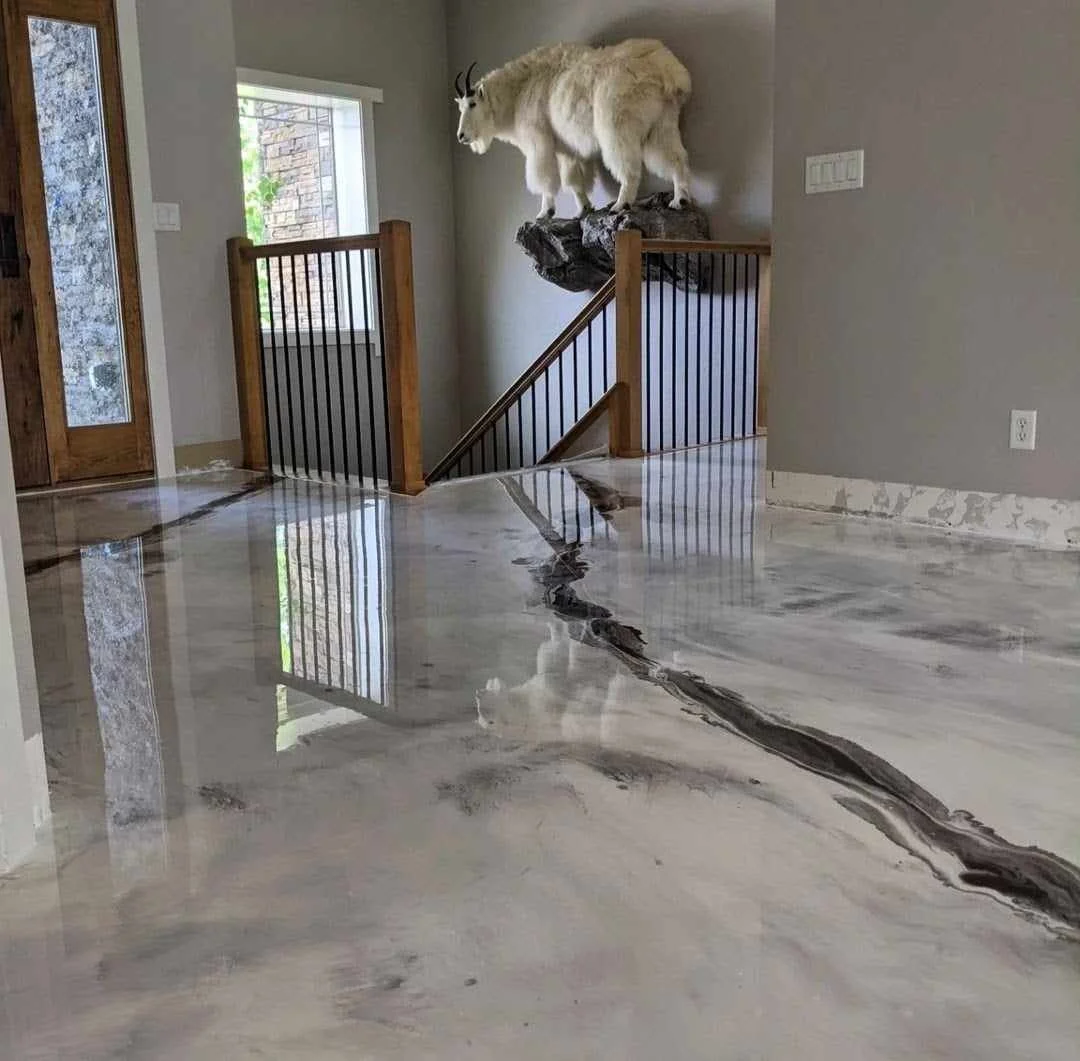
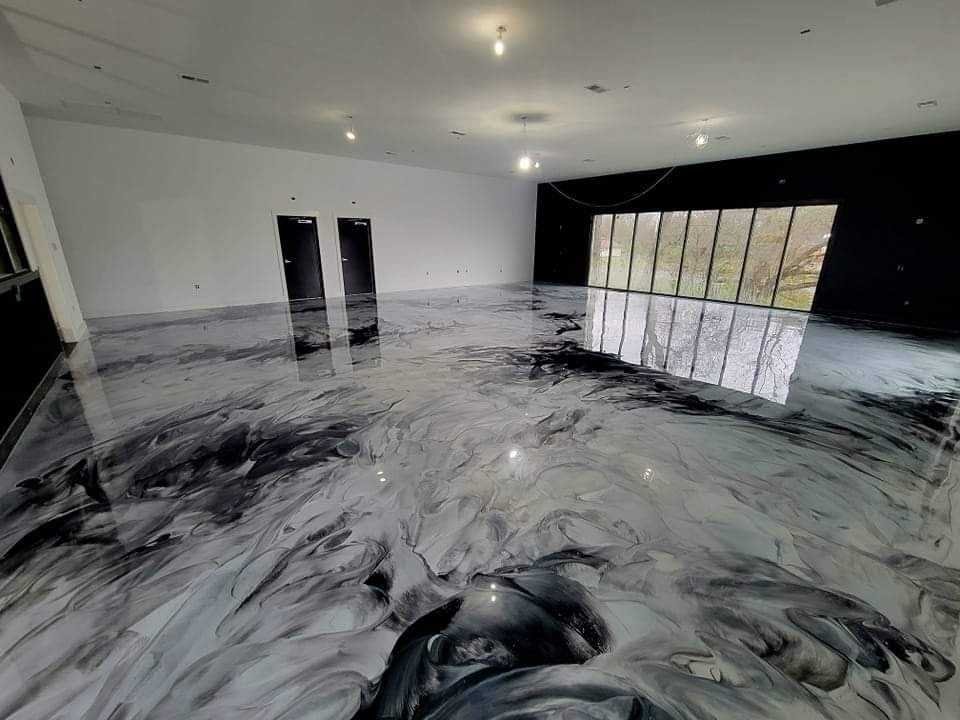
    A metallic epoxy floor from Skinner Customs starts at $8 per square foot. It is a high-gloss, one-piece floor with a marble, stone or flowing liquid-metal look, and every one is poured and worked by hand, so no two come out the same. It works in basements, bathrooms, entries, kitchens, shops and garages. In a garage that gets parked on, the topcoat is what makes it last.

    Skinner Customs installs metallic floors across Idaho Falls, Rexburg, Rigby, Ammon, Pocatello, Blackfoot, Driggs, Victor and Jackson, all year round, with the building heated through the cure in winter. Below is what it costs, where it works, and the trade-offs nobody mentions until after the install.

    What a metallic epoxy floor actually is

    A metallic floor is a clear epoxy loaded with fine metallic pigment. Once it is poured, the installer works it with rollers, brushes and tools to push the pigment around and create movement, veining and depth. As the epoxy levels and cures, the pigment settles into those patterns and catches the light. That is where the marble, stone and liquid-metal looks come from.

    Because the pattern is made by hand in the wet coating, every floor is one of a kind. You pick the colors and the general look, and the floor itself comes out a little different every time.

    What a metallic floor costs

    Metallic floors at Skinner Customs start at $8 per square foot on a sound slab. Here is what that looks like by space:

    Space Typical size Starting price
    Entry or mudroom About 100 sq ft From about $800
    1-car garage About 250 sq ft From about $2,000
    Living room or open area About 400 sq ft From about $3,200
    2-car garage About 450 sq ft From about $3,600
    Basement About 800 sq ft From about $6,400

    Small rooms like bathrooms usually run above the per-foot rate, because setup and prep take about the same time whether the room is 50 square feet or 500. Crack repair, old flooring or adhesive removal, moisture problems and stairs add to the number. For comparison with flake and solid floors, see our Garage Floor Coating Cost in Idaho Falls guide.

    Where metallic epoxy works best

    Basements. The most common place for it. A metallic floor turns a plain concrete basement into a finished space without carpet, tile grout or flooring that cares about a little moisture. Test the slab for moisture first.

    Bathrooms and laundry rooms. One continuous surface means no grout lines to scrub and nowhere for water to sit. Accent colors, like a blue “river” running through a white floor, work well in small rooms.

    Entries, kitchens and living areas. A white or grey marble look in an entry makes the first impression of the whole house.

    Garages and shops. Yes, including garages that get parked on. The key is the topcoat. A tough, UV-stable topcoat over the metallic layer takes the tires, salt and scuffs so the pattern underneath stays clean.

    The honest trade-offs

    • Gloss shows dust and scratches. A high-gloss floor shows footprints and dust more than a flake floor does. A satin topcoat helps.
    • It can be slick when wet. In garages, entries and bathrooms, ask for an anti-slip additive in the topcoat.
    • Repairs do not blend invisibly. Because every pattern is unique, a damaged spot is hard to patch without it showing. That is another reason the topcoat matters.
    • Sun can yellow epoxy. Spaces with a lot of direct sun need a UV-stable topcoat or the floor can amber over time.
    • The slab has to be sound. Cracks get repaired and the slab gets ground flat first. A metallic floor will not hide a slab that is still moving.

    Picking colors

    The looks that come up most around here:

    • Grey and silver. The safest pick for garages, shops and basements. Hides dust better than the extremes.
    • White marble. Bright and high-end for entries, kitchens and bathrooms.
    • Black and silver. Dramatic, with deep veining. Shows dust more than grey.
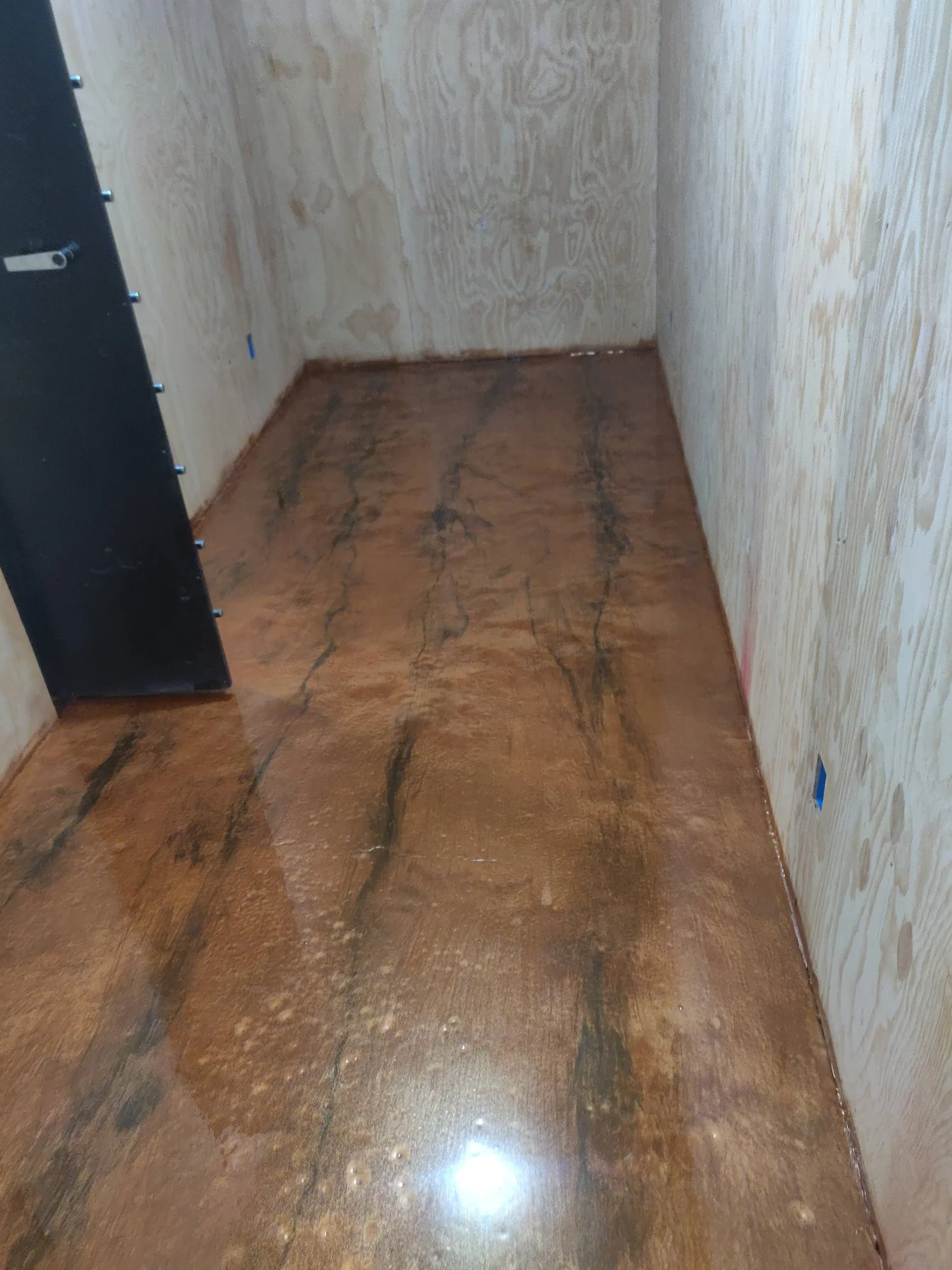
    • Copper and bronze. Warm tones that pair well with wood trim and cabin-style homes.
    • Accent rivers. A contrasting color, like blue or teal, poured through a lighter base.

    How a metallic floor goes in

    1. Prep. Grind the slab, repair cracks and clean it. In winter, heat the building ahead of time so the slab is warm.
    2. Base coat. A primer or base coat seals the concrete and gives the metallic layer a uniform start.
    3. Metallic coat. The pigmented epoxy is poured and worked by hand to build the pattern.
    4. Topcoat. A clear protective topcoat goes on once the metallic layer cures, with anti-slip added where needed.
    5. Cure. Plan on 2 to 3 days before you park on it or move heavy furniture back in. You can walk on it sooner.

    Installing in the cold months? Here is how we handle a winter epoxy install in Eastern Idaho.

    Metallic vs. flake

    Flake is the practical workhorse. It hides dirt, gives great grip and costs less. Metallic is the showpiece. It looks like stone, it has no grout lines, it shines, and it costs more. Plenty of people put flake in the garage and metallic in the basement. We compared flake, solid epoxy and polyaspartic in Flake vs. Solid Epoxy vs. Polyaspartic.

    Frequently asked questions

    How much does a metallic epoxy floor cost in Idaho Falls?
    At Skinner Customs, metallic floors start at $8 per square foot on a sound slab. A two-car garage starts around $3,600 and an 800 square foot basement around $6,400. Slab repairs are extra.

    Can you put a metallic epoxy floor in a garage?
    Yes. We install metallic floors in garages that get parked on. A tough, UV-stable topcoat over the metallic layer is what makes it hold up to tires and salt.

    Is a metallic floor slippery?
    High gloss can be slick when wet. An anti-slip additive in the topcoat fixes most of that, and we recommend it in garages, entries and bathrooms.

    Can you install metallic epoxy in winter?
    Yes. We install all winter and heat the building before, during and after the install so the slab stays warm through the cure.

    How long before I can use the floor?
    Plan on 2 to 3 days before you park on it or move heavy furniture back in. Light foot traffic comes sooner.

    Want to see what it would look like in your space?

    Send a few photos of the room or garage, the rough size, and any colors or floors you like the look of. We will tell you what fits and what it costs.

    Need a metallic epoxy floor in Eastern Idaho? Call Zach at Skinner Customs at (208) 390-5794 or start at skinner-customs.com.


    Content produced in partnership with S4 Media, marketing partner of SwagerBuilds LLC.
  • Can You Install an Epoxy Garage Floor in Winter? What Works in Eastern Idaho

    Can You Install an Epoxy Garage Floor in Winter? What Works in Eastern Idaho

    Yes, you can install an epoxy or flake garage floor in winter in Eastern Idaho. What matters is the right product and a warm slab, because cold concrete, not cold air, is what ruins a winter install. Standard epoxy needs the slab at roughly 55°F or warmer, and it has to stay warm through the cure. Polyaspartic systems are built to cure on colder concrete. In an attached garage that is heated before, during and after the install, winter works fine for a garage floor.

    Skinner Customs installs garage, shop and basement floor coatings all winter across Idaho Falls, Rexburg, Rigby, Ammon, Pocatello, Blackfoot, Driggs, Victor and Jackson, and we heat the garage before, during and after the install. This is how a cold-weather install works and what to plan for.

    The number that matters is slab temperature

    Air temperature is easy to fix. Turn on a heater and the garage is 60°F in a couple of hours. The concrete lags far behind. A slab on grade in January can sit in the 30s or low 40s even when the air above it feels comfortable, and the coating reacts at the temperature of the concrete it is touching.

    Most coating manufacturers spell out three checks on their data sheets:

    • Slab temperature. Standard 100% solids epoxy generally needs the slab at 55°F or above. Below about 50°F, many epoxies cure slowly, cure soft or stop curing. Cold-cure epoxies and polyaspartics are rated lower, and some polyaspartic and polyurea products go down on slabs in the 30s.
    • Dew point. The slab should stay at least 5°F above the dew point through the cure. If it does not, moisture condenses on the surface and the coating will not bond or will cloud.
    • Staying warm. The slab has to hold that temperature through the first day or more of cure, not just during application.

    That is why a winter install starts with an infrared thermometer pointed at the floor, not at the thermostat. For the same reason on the pouring side, see cold weather concrete curing in Idaho.

    How a winter install actually works

    1. Check the slab ahead of time. Slab temperature, moisture and the forecast for install week.
    2. Heat the garage 24 to 48 hours before. Long enough for the concrete itself to warm up. Uninsulated or detached buildings can take longer.
    3. Close up the drafts. Door seals, gaps and open vents get covered so the heat stays in.
    4. Grind, repair and clean. In winter this includes getting every trace of salt residue out of the slab. Salt left in the pores is a common reason coatings lift.
    5. Apply the system. Base coat, full flake broadcast, scrape, topcoat.
    6. Keep the heat on through the cure. At least a full day after the last coat, longer for epoxy in a cold building.
    7. Wait before parking. On our floors, plan on 2 to 3 days with the heat kept on through the cure.

    One thing to avoid: open-flame and unvented propane or kerosene heaters. They put moisture and combustion gases into the air, which can leave a cloudy, greasy film on curing epoxy called amine blush, and they are not safe to run in a closed garage. Indirect-fired or electric heaters are the right tools.

    Which coatings work in the cold

    System Typical minimum slab temperature Winter notes
    Standard 100% solids epoxy About 55°F Needs a well-heated garage before and after. Longest cure in the cold.
    Cold-cure epoxy About 45°F Formulated to react at lower temperatures, with a shorter working time.
    Polyaspartic Often about 35°F to 40°F Cures fast even when cool. A strong winter choice.
    Polyurea Some products lower still Very fast cure. Product-specific limits.

    These are typical ranges. The product data sheet for the exact coating being used is what governs.

    A full-flake floor with an epoxy base and polyaspartic topcoat is only as cold-tolerant as its epoxy base. If your garage is hard to heat, a full polyaspartic system is usually the better winter pick. We compared the systems side by side in Flake vs. Solid Epoxy vs. Polyaspartic.

    Attached garages vs. detached shops

    Attached garages pick up heat from the house and usually run noticeably warmer than outside, so they are the easiest winter installs. A detached garage, pole barn or shop with no insulation in the slab or walls is a different job. It takes longer to bring the concrete up to temperature and more heat to hold it there, and on the coldest stretches of January it can make sense to wait for a milder week.

    How long before you can park on it?

    On floors we install, plan on 2 to 3 days before you park, with the garage kept heated through the cure. You can walk on it sooner. A very cold detached building can stretch that a little, and we will give you the exact time for your floor before we start.

    Plan the install around the forecast too. Parking on a fresh floor with tires full of snow and de-icer is the last thing you want in the first week.

    Why winter is a good time to do it

    • Outdoor concrete slows down. Driveways and patios do not get poured in January, which is why interior coatings are a natural winter project.
    • The sooner it is down, the less salt the bare slab takes. Every storm that soaks salty meltwater into bare concrete adds to the pitting near the door.
    • It is done before spring. When the garage door is open again in April, the floor is already finished.

    Frequently asked questions

    What is the coldest temperature you can install epoxy?
    For standard epoxy, the slab should be about 55°F or warmer and stay above about 50°F through the cure. Polyaspartic and some polyurea products are rated for colder slabs. Always go by the data sheet for the specific product.

    Can I park in the garage while the floor cures?
    No. The floor needs to be completely clear from prep through cure, and vehicles stay out until the installer says the floor is ready.

    Do I need to empty the whole garage?
    Yes. The whole floor gets ground and coated, so everything sitting on it has to come out, including shelving that sits on the slab.

    Can you coat a garage floor that has salt stains and pitting?
    Yes. Salt residue gets cleaned and ground out, and pits and spalls get filled and ground flat before the coating goes down. Most garage floors in this area have some of that by the time they get coated.

    Will the heat make my garage smell?
    Some coatings have an odor during application and early cure. Polyaspartic and solvent-based products are stronger than water-based ones. Ask your installer which product they are using and how long to keep the door to the house closed.

    Planning a winter garage floor?

    Send a few photos of the floor, the garage size, whether the garage is attached and heated, and when you need to be parking on it again. We will tell you which system fits a winter install in your garage and what it costs. Prices start at $6 per square foot; see the garage floor coating cost guide for full numbers.

    Need a garage floor coating in Eastern Idaho? Call Zach at Skinner Customs at (208) 390-5794 or start at skinner-customs.com.


    Content produced in partnership with S4 Media, marketing partner of SwagerBuilds LLC.
  • Flake vs. Solid Epoxy vs. Polyaspartic: Which Garage Floor Holds Up to an Idaho Winter?

    Flake vs. Solid Epoxy vs. Polyaspartic: Which Garage Floor Holds Up to an Idaho Winter?

    For most garages in Eastern Idaho, the best floor is a full-flake system with a polyaspartic topcoat. The flake hides snowmelt residue and grit, the texture gives you grip on a wet floor, and a polyaspartic topcoat handles road salt, sun and hot tires better than an epoxy topcoat does. Solid-color epoxy still makes sense in a basement or a shop that never sees salt or sun. A full polyaspartic system is the upgrade if you want the fastest cure or need to install in a cold garage.

    Skinner Customs installs all three across Eastern Idaho, from Idaho Falls, Rexburg, Rigby, Ammon, Pocatello and Blackfoot to Driggs, Victor and Jackson. Here is how they compare when winter is the real test.

    What each system actually is

    Solid-color epoxy. A pigmented epoxy base coat rolled onto a ground slab, usually followed by a clear topcoat. Professional systems use 100% solids epoxy, which goes on much thicker than the water-based epoxy in hardware-store kits.

    Full-flake floor. A base coat goes down, then colored vinyl flakes are thrown onto the wet base until no base coat shows. That is called broadcasting to refusal. Once it cures, the loose flake is scraped and swept off and a clear topcoat locks it in. The base can be epoxy or polyaspartic. The topcoat is what you actually walk and drive on.

    Polyaspartic. A fast-curing coating in the polyurea family. It can be used as just the topcoat over an epoxy base, or for every layer. It cures in hours rather than a day or more, it does not yellow in sunlight, and many products are rated to go down on a colder slab than standard epoxy.

    How winter tests a garage floor

    • Salt and de-icer. Snow packed on your truck melts on the floor and leaves a salt film every time it dries.
    • Standing water. Meltwater pools in low spots and along the edges for days.
    • Freeze-thaw at the door. The first few feet inside the door freeze and thaw every time the door opens.
    • Grit. Sand and gravel off the roads grind into the surface under your tires and boots.
    • Temperature swings. The slab expands and contracts as the garage swings between freezing and warm.
    • Summer payback. Then July brings hot tires and afternoon sun through the open door.

    A floor that holds up here has to handle all of that, not just look good on install day.

    Head-to-head comparison

    Solid-color epoxy Full flake (epoxy base, polyaspartic top) Full polyaspartic flake
    Road salt and de-icer Fair. Can dull and etch with long exposure Good Very good
    Sun and yellowing Epoxy yellows in direct sun Good. Topcoat is UV-stable Very good
    Hot tire pickup A risk, especially with thin coats Low Low
    Grip when wet Slick unless grit is added Good. Flake adds texture Good
    Hides dirt, salt film and stains Poor Very good Very good
    Movement with temperature swings Rigid Moderate More flexible
    Cold-weather install Needs a warm slab, about 55°F or more Limited by the epoxy base Many products rated for colder slabs
    Installed cost at Skinner Customs From $6 per sq ft From $6 per sq ft From $8 per sq ft

    Whichever system you pick, plan on 2 to 3 days before you park on a new floor from us. Pricing is covered in more detail in our Garage Floor Coating Cost in Idaho Falls guide.

    The topcoat is the layer that matters most

    Most of what people like or hate about a garage floor comes down to the topcoat. It is the layer that takes the salt, the tires and the sun. An epoxy topcoat is cheaper, but it is softer, it ambers in UV and it is the layer most likely to lift under a hot tire. A polyaspartic or urethane topcoat is harder, stays clear in the sun and shrugs off salt. If you only upgrade one thing on a bid, upgrade the topcoat.

    Which system fits which space

    Daily-driver garage, door faces south or west. Full flake with a polyaspartic topcoat, or full polyaspartic. Sun and salt are both in play, so the topcoat has to handle both.

    Daily-driver garage, door faces north or east. Full flake with a polyaspartic topcoat is still the safe pick. Salt is the bigger enemy here than sun.

    Shop with jacks, jack stands and dropped tools. A thicker 100% solids epoxy base for impact strength, full flake, and a polyaspartic topcoat for chemical and salt resistance.

    Basement or finished room. Solid-color, flake or a decorative metallic epoxy all work, since there is no salt and little sun. Test for moisture first. Below-grade slabs can push vapor up and blister a coating that was not built for it.

    Mudroom or entry off the garage. Flake, for the grip and because it hides the dirt that comes in on boots all winter.

    Picking a flake color for an Idaho garage

    Mid-tone blends of grey, tan and black hide road grime and salt film best. Very dark solid floors show every white salt mark. Very light floors show every tire track. If you want the floor to look clean between washes in February, pick a blend with some light and some dark flake in it.

    Frequently asked questions

    Is a flake epoxy floor slippery when wet?
    Less than a solid floor, because the flake adds texture. If the garage sees a lot of meltwater, ask for an anti-slip additive in the topcoat.

    Does road salt ruin epoxy garage floors?
    Salt sitting on an epoxy topcoat for long periods can dull and etch it. A polyaspartic or urethane topcoat resists salt much better. Either way, rinsing the salt film off a few times a winter keeps the floor looking new.

    Can you put polyaspartic over an existing epoxy floor?
    Often, yes, if the old epoxy is still well bonded. It gets sanded or ground so the new coat can bond. Anything peeling has to come off first.

    What is the difference between polyurea and polyaspartic?
    Polyaspartic is a type of polyurea that reacts more slowly, which gives the crew time to apply it evenly. In garage floor talk the two names get used almost interchangeably.

    How do I clean a flake garage floor in winter?
    Squeegee standing meltwater out the door, then rinse with water and a mild cleaner every few weeks to lift salt film. Skip acidic cleaners and harsh solvents.

    Not sure which system fits your garage?

    Send a few photos of the floor, the garage size and which way the door faces, and tell us how you use the space. We will tell you which system fits and what it costs before anyone grinds anything.

    Need a garage floor coating in Eastern Idaho? Call Zach at Skinner Customs at (208) 390-5794 or start at skinner-customs.com.


    Content produced in partnership with S4 Media, marketing partner of SwagerBuilds LLC.
  • Garage Floor Coating Cost in Idaho Falls (2026): Epoxy, Flake and Polyaspartic

    Garage Floor Coating Cost in Idaho Falls (2026): Epoxy, Flake and Polyaspartic

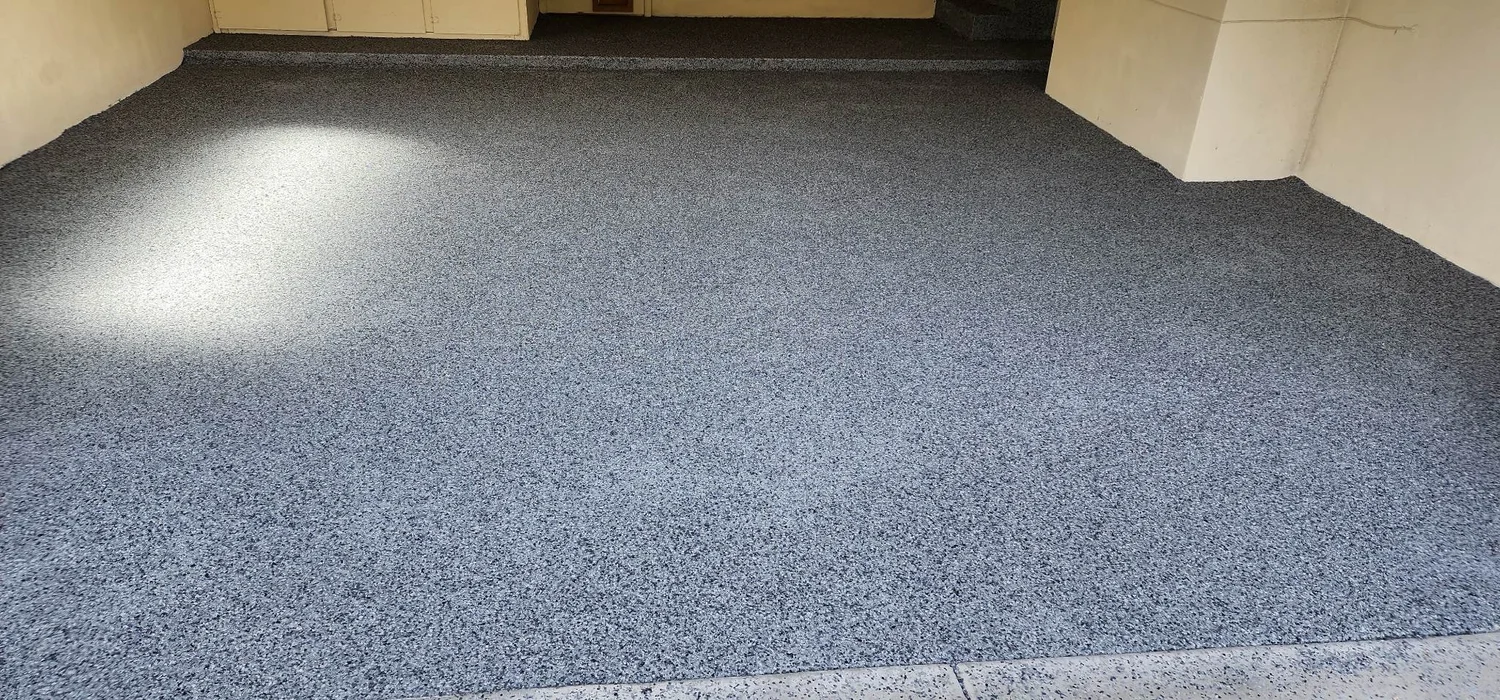
    A professionally installed garage floor coating from Skinner Customs starts at $6 per square foot for solid-color epoxy or a full-flake floor, and at $8 per square foot for a full polyaspartic system. For a typical two-car garage of around 450 square feet, that puts a solid or flake floor at about $2,700 and up before any slab repairs. The condition of your slab can move the number more than the coating you pick.

    Skinner Customs installs garage, shop and basement floor coatings across Eastern Idaho: Idaho Falls, Rexburg, Rigby, Ammon, Pocatello and Blackfoot, plus Driggs, Victor and Jackson. Below are the numbers, what drives them, and what to look for on a bid.

    The three systems and what they cost

    Almost every residential garage coating in this area falls into one of three systems.

    Solid-color epoxy: from $6 per square foot. A pigmented epoxy base coat, usually with a clear topcoat. It looks clean and costs the least, but it shows every tire mark and drip of snowmelt, it can be slick when wet unless grit is added, and epoxy topcoats tend to yellow where the sun hits through an open door.

    Full-flake floor with an epoxy base and polyaspartic topcoat: from $6 per square foot. This is the most common garage floor around here. The base coat goes down, vinyl flakes are broadcast until the floor is fully covered, the loose flake is scraped off, and a clear polyaspartic topcoat seals it. The flake hides dirt, salt film and hairline cracks, and the texture gives your boots something to grip.

    Full polyaspartic (or polyurea) flake system: from $8 per square foot. Same look as the flake floor, but every layer is fast-curing polyaspartic or polyurea. You pay more, and you get a floor that cures faster, handles UV without yellowing, and can be installed in a colder garage.

    Garage size Solid epoxy or full flake Full polyaspartic
    1-car (about 250 sq ft) From about $1,500 From about $2,000
    2-car (about 450 sq ft) From about $2,700 From about $3,600
    3-car (about 700 sq ft) From about $4,200 From about $5,600

    These are starting prices for a sound slab. Crack and spall repair, old coating removal, oil-soaked spots and moisture problems add to the number, and so do stem walls and extra-heavy shop topcoats. Small single-stall garages can also run above the starting rate, because setup and travel get spread over less floor.

    Prep is where the price moves

    Two garages the same size can get very different quotes, and the difference is almost always the slab, not the coating. A coating is only as good as its bond to the concrete, and the bond comes from prep.

    Diamond grinding. The floor gets ground with a diamond grinder to open the surface so the base coat can bite in. This should be built into any professional quote. If a bid says acid etch instead of grinding, ask why.

    Crack and spall repair. Years of salty snowmelt dripping off trucks pits and flakes the top of a garage slab, especially in the first few feet inside the door. That damage gets filled and ground flat before any coating goes down.

    Old coating removal. Peeling paint or a failed DIY kit has to come off completely. Coating over it just means the new floor fails where the old one did.

    Oil and contamination. Oil-soaked spots under where the truck has parked for ten years need extra cleaning or grinding, or the coating will not stick there.

    Moisture mitigation. Mostly a basement issue. Below-grade slabs can push moisture vapor up through the concrete, and a standard coating will blister. A moisture test tells you whether you need a vapor-blocking primer.

    Why Eastern Idaho garages are hard on coatings

    A garage floor here gets a rougher winter than most. Trucks come in packed with snow, ice and road de-icer. That meltwater pools, dries and leaves a salt film. The first few feet inside the door go through freeze-thaw every time the door opens. Then summer brings hot tires and afternoon sun through a west- or south-facing door.

    That combination is why the topcoat matters so much. A thin epoxy topcoat can dull, yellow and lift under hot tires. A polyaspartic or urethane topcoat holds up to salt, UV and hot tires far better, and it is the main reason the flake systems cost what they do.

    If you want the long version of what winter does to bare concrete, we covered it in what winter actually does to concrete in Eastern Idaho.

    Coating vs. sealing vs. doing nothing

    Sealing is the cheaper option. A penetrating sealer soaks into the concrete and helps keep water and salt out, but it does not change how the floor looks and it does not give you a wear surface. It is the right call for driveways and sidewalks. We broke down sealer pricing in concrete sealing cost in Eastern Idaho and which products work in the best concrete sealer for a cold climate.

    Coating puts a new surface on top of the slab. Salt, oil and snowmelt sit on the coating instead of soaking into the concrete, and the floor cleans up with a squeegee and a hose.

    Doing nothing is fine on a slab that stays dry. On a garage floor that takes salt every winter, bare concrete pits and spalls over time, and repairing a spalled slab costs more than coating a sound one.

    DIY kits vs. a professional install

    Big-box epoxy kits run a few hundred dollars for a two-car garage. They are usually water-based, much thinner than a professional system, and rely on acid etching instead of grinding. They can look good for a season. The common failure is hot-tire pickup, where the coating peels up under your tires in the first summer, plus wear and peeling inside the door where the snowmelt sits.

    If you want a floor that lasts, the difference is grinding, a thick base coat, full flake coverage and a real topcoat. That is the part you are paying a crew for.

    What to check on a garage floor coating bid

    • Prep method. Does it say diamond grinding? Grinding beats acid etching for bond.
    • Base coat. What product, and is it 100% solids or water-based?
    • Flake coverage. Full broadcast (floor fully covered) or a partial sprinkle?
    • Topcoat. Polyaspartic, polyurea or urethane topcoats hold up better to salt and sun than an epoxy topcoat.
    • Crack and spall repair. Included, or billed per foot after they start grinding?
    • Moisture. Will they test the slab, especially in a basement?
    • Stem walls and edges. Is the curb or stem wall around the garage included?
    • Return to service. When can you walk on it, and when can you park on it?

    Frequently asked questions

    How much does it cost to coat a 2-car garage in Idaho Falls?
    For about 450 square feet, a solid-color or full-flake floor from Skinner Customs starts around $2,700, and a full polyaspartic system starts around $3,600. Slab repairs are extra.

    How soon can I park on a new garage floor?
    Plan on 2 to 3 days before you park on a new floor from us. You can walk on it sooner. We will give you the exact time for your floor before we start.

    Is polyaspartic worth the extra money?
    It usually is if your garage door faces the sun, you want to park on the floor sooner, or you are installing in cold weather. In a basement or a shop with no sun and no salt, an epoxy system holds up fine.

    How long does a garage floor coating last?
    A properly prepped, professionally installed system with a polyaspartic or urethane topcoat is commonly rated for 10 to 20 years of residential use. Thin DIY kits often fail within a few years.

    Can you coat a garage floor in winter?
    Yes, as long as the slab is warm enough and stays warm through the cure. We explain how it works in Can You Install an Epoxy Garage Floor in Winter?

    Do I need to seal my garage floor before coating it?
    No. The coating does the job a sealer would. If a penetrating sealer is already on the floor, it has to be ground off first so the base coat can bond.

    Will a coating hide cracks?
    A full-flake floor hides hairline cracks and old stains well. Cracks that are still moving get repaired first, and a crack that keeps moving can still show through over time.

    Getting a real number for your garage

    The fastest way to a real price is a few photos and a measurement. Send the garage size (or length and width), one wide photo of the whole floor, close-ups of any cracks, pitting, oil stains or old coating, and which direction the door faces. Let us know when you need to be parking on it again. From there we can tell you which system fits and what it will cost.

    Need a garage floor coating in Eastern Idaho? Call Zach at Skinner Customs at (208) 390-5794 or start at skinner-customs.com.


    Content produced in partnership with S4 Media, marketing partner of SwagerBuilds LLC.