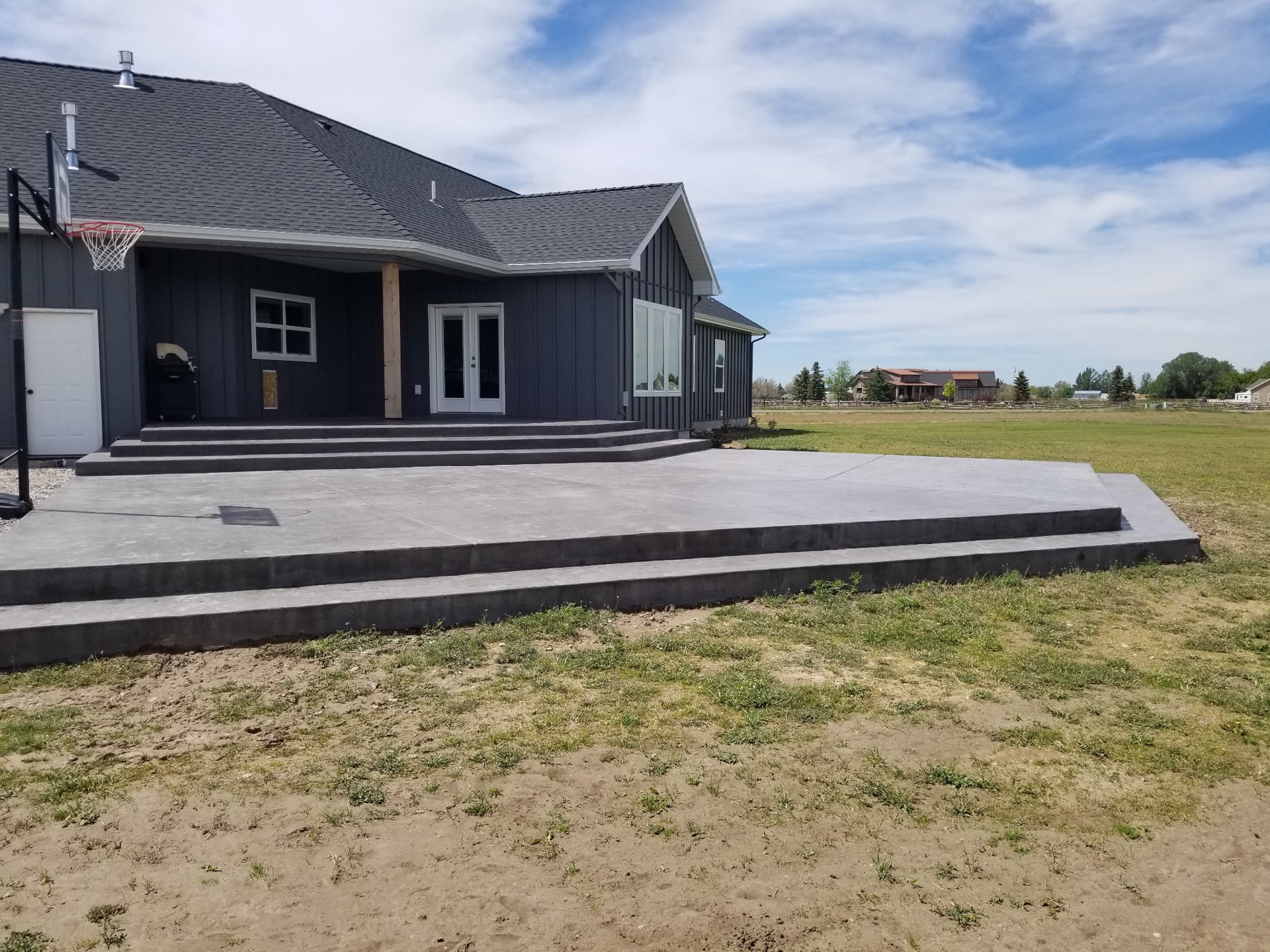
Winter concrete damage in Eastern Idaho is not caused by cold. It is caused by water that is already inside your slab when the temperature crosses 32 degrees — over and over, sometimes twice in the same day. Water expands about 9 percent when it freezes. A slab that has soaked up moisture all fall gets pushed apart from the inside every time that happens.
I run Skinner Customs out of Rigby. We pour and repair flatwork across Jefferson, Bonneville, and Madison counties, and this is the single most common thing I get called about in April: a driveway that looked fine in October and looks chewed up by spring. It is almost never a bad pour. It is a slab that went into winter unprotected.
Here in Rigby, the National Gardening Association’s frost data puts the first frost risk around September 7, with a 50 percent chance of hitting 32 degrees by roughly September 20. Idaho Falls starts a little earlier. That is your real deadline, and it is closer than most people think.
The two things that wreck concrete here
There are only two, and they compound each other.
Freeze-thaw cycling. Concrete is porous. It holds water the way a sponge does, just more slowly. When that water freezes it expands and pushes outward on the pore walls. When it thaws it draws more water in. Our high-desert valley climate is unusually hard on concrete because we do not just freeze once and stay frozen — we swing above and below 32 degrees repeatedly through the winter, sometimes inside a single 24-hour period. A slab in a place that freezes in November and stays frozen until March gets fewer damage cycles than a slab in Rigby.
Salt scaling. De-icing salt makes it worse in two ways. It lowers the freezing point, which means more freeze-thaw cycles at temperatures that would otherwise have left your concrete alone. And it is hygroscopic, so it actively pulls moisture into the surface. Sodium chloride and calcium chloride are the two worst offenders, and both come off the county roads on your tires and get deposited on your driveway whether you spread any yourself or not.
What the damage actually looks like
People use “spalling” and “scaling” interchangeably. They are different failures with different causes, and telling them apart tells you what went wrong.
Scaling is the top layer going. The surface paste flakes off in thin sheets, maybe an eighth of an inch, and the sand underneath starts showing through. It looks like the concrete has gotten rough and sandy in patches, usually worst where water sits or where you park a car that drips road salt off the wheel wells. Scaling is a surface-durability problem — bad air entrainment, an overworked or overwatered finish, or de-icing salt on concrete that was never sealed.
Spalling is deeper. Chunks pop off, quarter-sized to palm-sized, leaving craters that expose the aggregate. It often starts at joints, edges, and cracks, because that is where water gets in fastest. If you see rust staining in the crater, water has reached rebar and you have a bigger problem than a surface issue.
Pop-outs are small cone-shaped divots, usually the size of a nickel, with a piece of aggregate at the bottom. That is a single porous stone in the mix absorbing water and freezing. Cosmetic, not structural.
Joint deterioration — crumbling and widening at the control joints — is usually the first thing to show up, because joints are an open path straight into the slab.
The honest read: scaling and pop-outs are cosmetic-to-moderate. Spalling with exposed rebar means the clock is running.
Why some slabs survive and others do not
Three things decide it, and two of them are settled before the truck leaves.
Air entrainment. Air-entrained concrete has millions of microscopic bubbles deliberately mixed in. They give freezing water somewhere to expand into instead of pushing on the paste. For exterior flatwork in a freeze-thaw climate the accepted target is roughly 5 to 7 percent entrained air. This is not optional here, and it is the number one reason a driveway poured by somebody’s cousin comes apart in three winters. Ask for the mix ticket.
Water-to-cement ratio. More water makes concrete easier to place and weaker when it sets. A wet, sloppy pour gives you a porous surface that drinks moisture all winter. Every Skinner Customs exterior pour is 4,000 PSI minimum for exactly this reason.
Finish and cure. Overworking the surface with a power trowel on exterior concrete brings fines and water to the top and creates a dense skin that can delaminate. A broom finish is not just for traction — it is the correct finish for exterior flatwork in this climate.
If your slab has all three right, sealing is protection. If it has them wrong, sealing buys you time but will not save it. I would rather tell you that up front than sell you a seal job on a slab that is already failing.
The first winter rule
New concrete is the most vulnerable concrete. Do not put any de-icing chemical on a slab in its first winter — not rock salt, not ice melt, not the pet-safe stuff. Use sand for traction instead. Concrete keeps gaining strength for months after the pour, and the surface has not fully hardened against chemical attack yet.
That rule matters right now for anybody who poured this spring or summer. If we did your driveway or patio this season, sand only through spring 2027.
What to do before the first hard freeze
Short list, in order of what actually moves the needle.
- Get water off the slab. Clean out the control joints. Make sure downspouts discharge past the concrete, not onto it. Check that the grade still falls away from the slab — irrigation and settling change that over a few seasons. A slab that sheds water is doing most of the work for you.
- Fill open cracks and failing joints. Any crack wide enough to take a credit card is a funnel. Sealant is cheap. Water in a crack that freezes turns a hairline into a structural problem.
- Seal it, if the surface temperature will cooperate. Penetrating sealers need surface temps consistently above about 50 degrees and a clear window with no freeze for the cure. That window closes here in early to mid October most years.
- Switch off salt. Sand, or magnesium chloride if you must use a chemical. Keep it off decorative and stamped work entirely.
- Do not chip ice with a steel blade. A plastic shovel and a poly-edged blade on the plow. Most of the edge damage I see was done by equipment, not weather.
Repair now or wait until spring?
If the damage is surface scaling and the slab is otherwise sound, you can wait — but seal it and stay off the salt so it does not get worse over the winter. If you have spalling at joints with water actively getting in, address it before freeze-up, because every cycle between now and April makes the repair bigger.
If the slab is settled, heaving, or cracked all the way through in multiple places, sealing and patching is money spent on a slab that is already lost. Our flatwork pricing starts at $8 per square foot, and a driveway replacement in Rigby runs $8 to $13 per square foot installed. Sometimes the honest answer is that a $900 repair on a $12,000 slab is the wrong trade — and sometimes it is exactly the right one. It depends on what is under it, which is why I look before I quote.
For homeowners weighing a repair against a tear-out, the cost to replace a driveway in Rigby is the number to hold the repair estimate against.
On new construction we settle this at the design stage. When we pour for a custom home builder in Rigby, drainage, slab slope, and the sealing schedule get decided before anything is placed, which is far cheaper than solving it from the outside two winters later.
Frequently asked questions
Is spalling concrete a structural problem? Usually not on its own. Surface scaling and pop-outs are cosmetic. Spalling that exposes rebar is different — once water reaches steel, the steel rusts, rust expands, and it drives more concrete off. That one needs attention.
Can you fix spalled concrete, or does it have to be replaced? Sound slabs with surface damage can be resurfaced with an overlay, which is far cheaper than replacement. Slabs that are settling, heaving, or cracked through the full depth should be replaced. An overlay on a failing slab is a nice finish on a failing slab.
Does sealing actually prevent freeze-thaw damage? It prevents the water absorption that causes it, which is most of the battle. A penetrating sealer keeps liquid water and dissolved salt out of the pore structure. It does not fix concrete that was poured without air entrainment.
Why does my neighbor’s driveway look fine and mine does not? Almost always mix and finish, not luck. Air entrainment, water content, and whether the surface was overworked. Sun exposure and drainage explain the rest — a north-facing slab that stays damp cycles more than a south-facing one that dries out.
Is it too late in the season to seal? In Eastern Idaho, early September is close to ideal — the slab is dry from summer and daytime surface temps are still well above 50 degrees. By mid-October you are gambling on the cure. If you are reading this in November, wait for spring and focus on drainage and de-icer discipline instead.
Get a straight answer on your slab
If you have flaking, craters, or joints coming apart and you are not sure whether it is a seal job, a resurface, or a replacement, send photos and I will tell you which one it is. I will also tell you when the answer is “leave it alone until spring.”
Need concrete work in Eastern Idaho? Call Zach at Skinner Customs — (208) 390-5794 — or start at skinner-customs.com
Content produced in partnership with S4 Media, marketing partner of SwagerBuilds LLC.
Leave a Reply