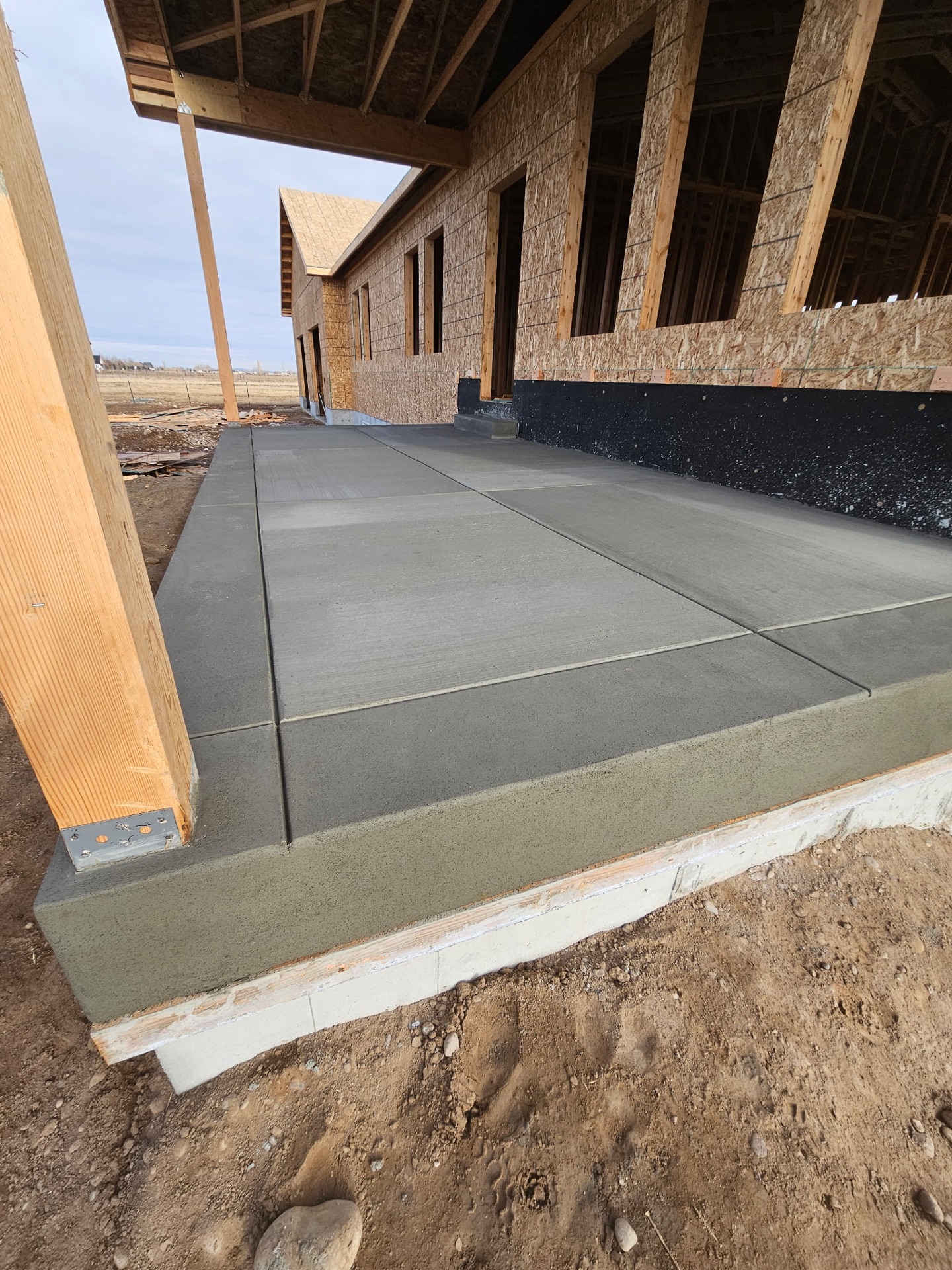
Cold weather concrete curing in Idaho is the part of a winter pour that decides everything, and it is the part nobody watches. The truck leaves, the crew leaves, the slab looks done. What happens over the next 48 hours is what separates a slab that lasts from one that is compromised before it ever carries a load.
I run Skinner Customs out of Rigby. We pour into the cold season when a job needs it. This is what that actually involves, so you know what you are buying and what to ask for.
The number that matters: 500 psi
Fresh concrete is mostly water, and water expands when it freezes. If it freezes inside a slab that has not developed any strength yet, the ice pushes the cement paste apart. The internal structure is damaged, and warming back up does not undo it. You have permanently lost strength and durability in a slab you will look at for thirty years.
NRMCA’s CIP 27, Cold Weather Concreting puts the threshold plainly: concrete must be protected from freezing until it reaches a compressive strength of 500 psi, which is roughly two days after placement. After that, the early freeze risk is behind you — but the slab still needs protecting from repeated freeze-thaw cycling until it is much stronger, on the order of 3,500 psi.
Two days of real protection. That is the commitment a winter pour makes.
What counts as cold weather
It is not a thermometer reading on pour day. NRMCA defines cold weather concreting as a period where, for more than three consecutive days, the average daily temperature stays below 40°F and the air temperature does not exceed 50°F for more than half of any 24-hour period.
By that definition, most of November through March in Rigby, Idaho Falls, and Rexburg is cold weather concreting. Our valley also swings hard between day and night, so an afternoon in the high 40s can still be a hard freeze by 2 a.m. The overnight low is what plans the pour, not the daytime high.
Placement temperature, before curing ever starts
Curing starts with what comes out of the truck. CIP 27 sets minimum concrete temperature as placed by section thickness:
| Section thickness | Minimum concrete temperature as placed |
|---|---|
| Less than 12 inches | 55°F |
| 12 to 36 inches | 50°F |
| 36 to 72 inches | 45°F |
Almost all residential flatwork — driveways, patios, garage floors, shop slabs — falls in that first row. That means the mix needs to arrive at 55°F or better, which usually means heated mix water from the plant, and that gets arranged in advance.
The base matters as much as the mix. We do not place on frozen ground, snow, or ice. Frozen subgrade thaws later and takes the slab down with it, and snow trapped under fresh concrete becomes a void. The ground gets thawed and cleared first, which on a cold site can mean blankets or heat on the subgrade the day before.
How the slab actually gets protected
Insulated blankets. The workhorse. Concrete curing generates its own heat, and blankets trap it. They go on as soon as the surface will take them without marring, and they stay on continuously. Edges and corners lose heat fastest and get extra attention — a corner that freezes while the middle is fine still ruins the corner.
Straw under plastic. An older method that still works when blankets are short, as long as the plastic is sealed against wind.
Enclosures and heat. For foundation walls, deep sections, or a very cold stretch, a tarped enclosure with heaters. If a fuel-fired heater is used inside an enclosure it has to be vented — unvented combustion puts carbon dioxide into the air and carbonates the fresh surface, leaving a soft, dusting slab.
Accelerating admixtures. ASTM C 494 Type C and Type E accelerators speed early strength gain so the slab clears 500 psi sooner. Calcium chloride is one option, dosed no higher than 2 percent by weight of cement. It is worth knowing that chlorides are a concern where steel is close to the surface, so this is a mix decision, not a default.
An accelerator is not a substitute for protection. It shortens the exposure window. It does not remove it.
Coming off protection without shocking the slab
The end of the protection period is its own step. Pulling blankets off a warm slab into 15°F air drops the surface temperature fast while the core is still warm, and that differential cracks the surface.
NRMCA’s curing guidance (CIP 11, Curing In-Place Concrete) holds the cooling rate to no more than 5°F per hour in the first 24 hours, and calls for keeping concrete above 50°F during curing. In practice that means peeling protection back gradually, and picking the warm part of the day to do it.
CIP 11 also makes the broader point worth hearing: concrete left to cure in a dry environment can lose as much as 50 percent of its potential strength compared with concrete that is properly cured. Curing is not a formality on any pour, cold or not.
What to ask before you sign a winter bid
A winter pour done right costs more than a July pour, because it is more work. If the price is the same, the protection is missing.
Ask these:
- Will the mix be delivered heated, and what placement temperature are you targeting?
- How will the subgrade be thawed and cleared?
- What protection goes on, and how long does it stay?
- Is anyone coming back to check it overnight or the next day?
- Is an accelerator being used, and which type?
- How does the protection come off?
A contractor who pours through winter regularly will answer all six without hesitating. Those answers should also appear as real line items on the bid, not be folded invisibly into a square-foot number.
When waiting is the better call
Sometimes the right answer is spring. If there is no deadline, no building going up over it, and no reason the slab has to exist in January, waiting for a normal-condition pour is cheaper and simpler.
Where a winter pour earns its keep: an interior slab inside a building that can be closed and heated, a foundation on a build with a schedule behind it, or a shop floor that has to be in before equipment arrives. Those are real reasons. “It’s cheaper in the off-season” is not one — done properly, it is not cheaper.
Frequently asked questions
How long does concrete need to be protected from freezing? Until it reaches about 500 psi compressive strength, roughly two days after placement. Protection from repeated freeze-thaw cycling continues until the concrete is much stronger.
What temperature should concrete be when it is placed in cold weather? For sections under 12 inches, which covers most residential flatwork, a minimum of 55°F as placed. Thicker sections can be placed cooler.
Can concrete be poured on frozen ground? No. Frozen subgrade thaws later and the slab settles into it. The ground must be thawed and free of snow and ice before placing.
Do concrete blankets really work? Yes. Concrete generates heat as it cures, and insulated blankets hold it in. They need full, continuous coverage — edges and corners lose heat first and are where cold weather damage usually shows up.
Does concrete poured in winter take longer to cure? Strength gain is slower in the cold, so the slab stays weak longer and protection has to last longer. Expect longer waits before driving on it or loading it.
Not sure whether to pour now or wait?
Tell me what the slab is for and what your deadline actually is, and I will tell you straight whether it is worth pouring this winter or whether spring is the smarter money.
Need concrete work in Eastern Idaho? Call Zach at Skinner Customs at (208) 390-5794 or start at skinner-customs.com.
Content produced in partnership with S4 Media, marketing partner of SwagerBuilds LLC.
Leave a Reply