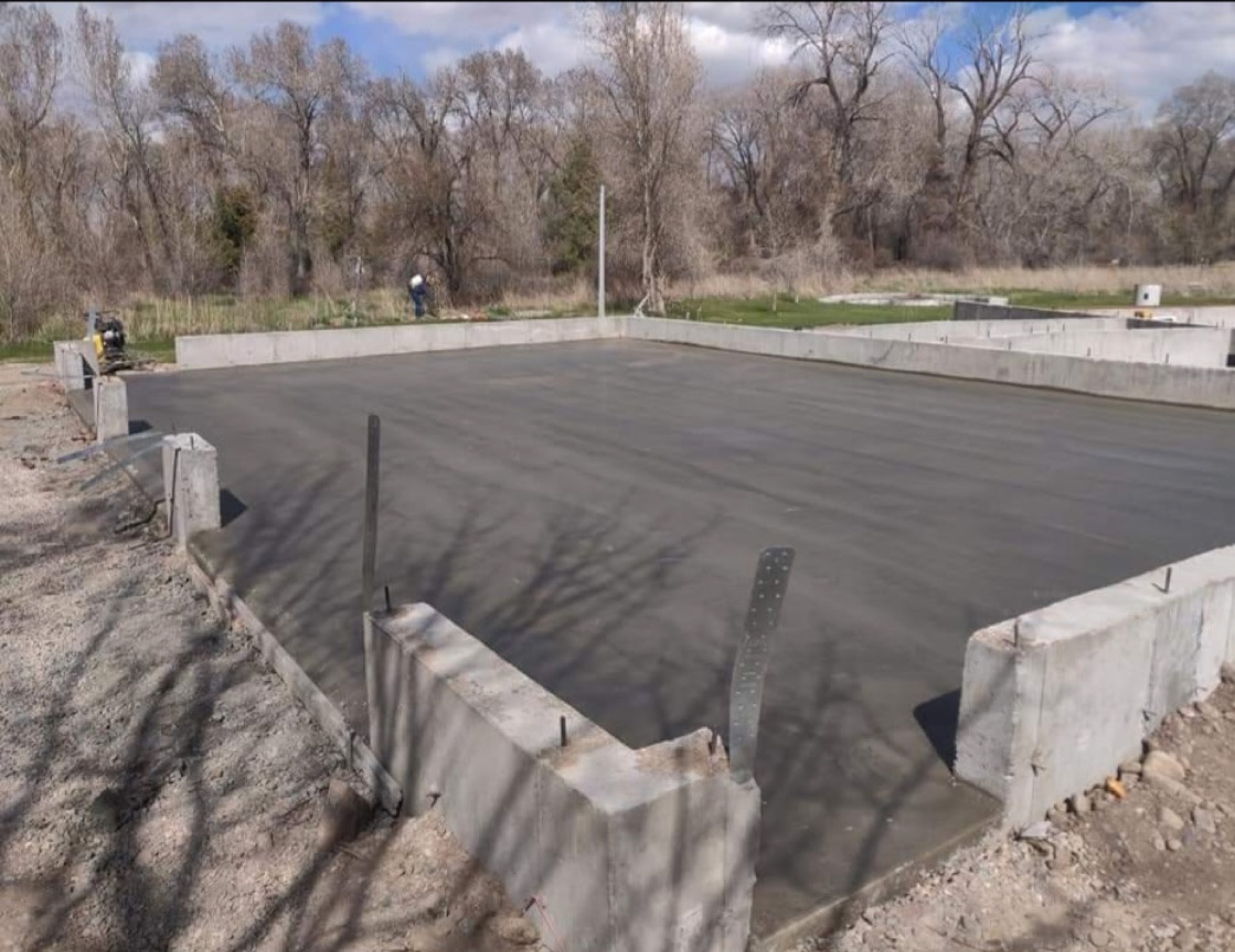
The concrete shop slab cost in Eastern Idaho runs $9 to $16 per square foot installed in 2026. A 40 x 60 shop — 2,400 square feet, the size most people around here build — lands between $21,600 and $38,400 depending on thickness, reinforcement, and what you plan to drive on it.
I run Skinner Customs out of Rigby. We pour shop slabs, pole barn floors, and equipment pads across Jefferson, Bonneville, and Madison counties. Shop slabs are the job where the difference between a good bid and a cheap bid shows up fastest, because the loads are real and the failure mode is expensive.
The single question that sets your price
Not square footage. Thickness — and thickness is driven by what rolls across it.
4 inches. Cars, light pickups, storage, a workbench. This is a garage floor, not a shop floor. If someone bids a 4-inch slab for a building you plan to put a tractor in, they either did not ask or did not listen.
5 inches. Three-quarter-ton and one-ton trucks, a car lift, an ATV and trailer, general hobby shop use. This is the honest minimum for most residential shops in this area.
6 inches. Tractors, skid steers, loaded trailers, a two-post lift with a heavy vehicle on it, dually trucks. Most working shops around Rigby and Idaho Falls should be at 6 inches.
8 inches with engineered reinforcement. Semi traffic, heavy equipment, commercial use. At this point the slab needs actual engineering, not a rule of thumb.
Every additional inch adds roughly $1.50 to $2.50 per square foot. On a 2,400 square foot shop, going from 4 inches to 6 costs about $7,200 to $12,000 more. That sounds like a lot until you price cutting out and repouring a failed slab inside a finished building — which runs three to four times the original cost because now everything has to be done by hand through a man door.
Pour it right the first time. You get exactly one easy shot at it.
Real cost by shop size in Eastern Idaho
| Shop size | Square footage | 5-inch slab | 6-inch slab |
|---|---|---|---|
| 24 x 30 | 720 sq ft | $7,200 – $9,400 | $8,600 – $11,500 |
| 30 x 40 | 1,200 sq ft | $12,000 – $15,600 | $14,400 – $19,200 |
| 40 x 60 | 2,400 sq ft | $24,000 – $31,200 | $28,800 – $38,400 |
| 50 x 80 | 4,000 sq ft | $40,000 – $52,000 | $48,000 – $64,000 |
| 60 x 100 | 6,000 sq ft | $58,000 – $76,000 | $70,000 – $93,000 |
Larger slabs get slightly better per-foot pricing because setup and mobilization spread across more area. These numbers assume 4,000 PSI mix, rebar reinforcement, compacted gravel base, vapor barrier, and a standard broom or light steel-trowel finish.
What a cheap shop slab bid leaves out
When a bid comes in dramatically low, it is almost always one of these five.
Wire mesh instead of rebar. This is the most common shortcut and the one I will not do. Wire mesh is supposed to sit mid-slab. In practice, the moment concrete goes down, crews walk it into the bottom of the pour and it sits there doing nothing. On a shop slab carrying point loads from jack stands, lift posts, and equipment tires, that is the difference between a slab that holds and one that cracks in a grid pattern within a few winters. Every Skinner Customs shop slab gets #4 rebar on an 18-inch grid, chaired up off the base so it stays where it belongs.
No vapor barrier. A 10 to 15 mil poly barrier under the slab runs a few hundred dollars on a shop-sized pour. Without it, ground moisture moves up through the slab continuously. You get a floor that sweats, rusts anything sitting on it, and will never hold an epoxy coating or paint. If you think you might ever coat that floor, the vapor barrier is not optional.
Thin or uncompacted base. Minimum 4 inches of compacted gravel, placed and compacted in lifts, more where the soil is soft. A lot of ground in this area is old farm ground with irrigation history and inconsistent fill. Skipping compaction saves a day and costs you a settled slab.
No thickened edges or footings. The slab perimeter carries the building. Thickened edges or a proper footing detail — sized to the building and to local frost requirements — is structural, not optional. Check with your county building department on frost depth requirements; in much of Eastern Idaho you are designing around 30-plus inches.
No control joints, or joints cut too late. Joints need to be cut within the first 6 to 18 hours depending on conditions, at spacing roughly 24 to 30 times the slab thickness in inches. On a 6-inch slab that is joints every 12 to 15 feet. Cut too late and the slab has already cracked where it wanted to.
Our flatwork pricing starts at $8 per square foot, and shop slabs run above that because of the added thickness and reinforcement. A shop slab bid under $8 in this market is not a bargain — it means one of the five items above came out.
Details worth paying for
Slope to the door. A quarter inch per foot of fall toward the overhead door means snowmelt off your truck runs out instead of pooling at the back wall. Free if it is planned, impossible to add later.
Floor drain. If you are washing equipment inside, plan the drain and the plumbing before the pour. Check with your county on discharge requirements — a shop drain that handles vehicle wash water may have restrictions on where it can go.
In-floor radiant heat. If there is any chance you want a heated shop, run the PEX before the pour. Adding tubing costs roughly $3 to $6 per square foot at pour time. Retrofitting heat into a finished shop means either an overlay slab or tearing out. Even if you are not ready to install the boiler, laying the loops and capping them is cheap insurance.
Saw-cut layout planned around the building. Joints should line up with column lines and door openings, not wander across the middle of your work bay.
Plan for coatings. If a polished, sealed, or epoxy floor is anywhere in your future, say so upfront. It changes the finish we put on the slab and it makes the vapor barrier non-negotiable. A hard steel-trowel finish that looks great bare can actually be too tight to bond a coating to properly.
If the shop is part of a larger build, get the concrete scope coordinated with the rest of the project early. On builds where we work with a trusted local builder, the slab specs get settled before the building is ordered, which avoids the common mess of a building package that assumes one foundation detail and a slab designed for another.
Timing your pour
Our reliable pour window in Eastern Idaho runs late April through early October. We pour outside that window with cold-weather additives, blankets, and ground heaters, and the results are fine when it is done right — but it costs more and it takes longer.
The bigger scheduling factor on shop slabs is sequencing. If the building is going up first, you are pouring inside a structure, which means pump access and hand work. If the slab goes first, you get truck access and a faster, cleaner pour. Talk through which order makes sense before anybody breaks ground, because it affects both cost and schedule.
Frequently asked questions
How thick should a shop slab be for a tractor? Six inches with #4 rebar on an 18-inch grid over a properly compacted base. A compact tractor might get by on 5 inches, but the incremental cost of going to 6 is small compared to the cost of being wrong.
Do I need a vapor barrier under a shop slab? Yes. It costs a few hundred dollars on a typical shop and it prevents ground moisture from moving through the slab. Without it you will have a floor that sweats and you will never successfully coat it.
How long before I can drive on a new shop slab? Light foot traffic at 24 to 48 hours. Passenger vehicles at 7 days. Heavy equipment at 28 days, when the concrete has reached design strength. Rushing heavy loads onto a green slab causes damage that shows up later as cracking.
Can you pour a slab inside an existing pole barn? Yes, and we do it regularly. It costs more per square foot because the truck cannot reach the pour area, so we are pumping and doing more hand work. Budget 15 to 25 percent above an open-site pour of the same size.
What PSI should a shop slab be? 4,000 PSI minimum in this climate. For heavy equipment traffic we will often go higher. Anything under 4,000 on a slab that sees freeze-thaw and real loads is a false economy.
Getting a real number for your shop
Shop slab pricing depends on size, thickness, site conditions, access, and whether the building is already up. Send the building dimensions, what you plan to drive on it, and photos of the site, and we can get specific.
Need concrete work in Eastern Idaho? Call Zach at Skinner Customs — (208) 390-5794 — or start at skinner-customs.com
Content produced in partnership with S4 Media, marketing partner of SwagerBuilds LLC.
Leave a Reply