
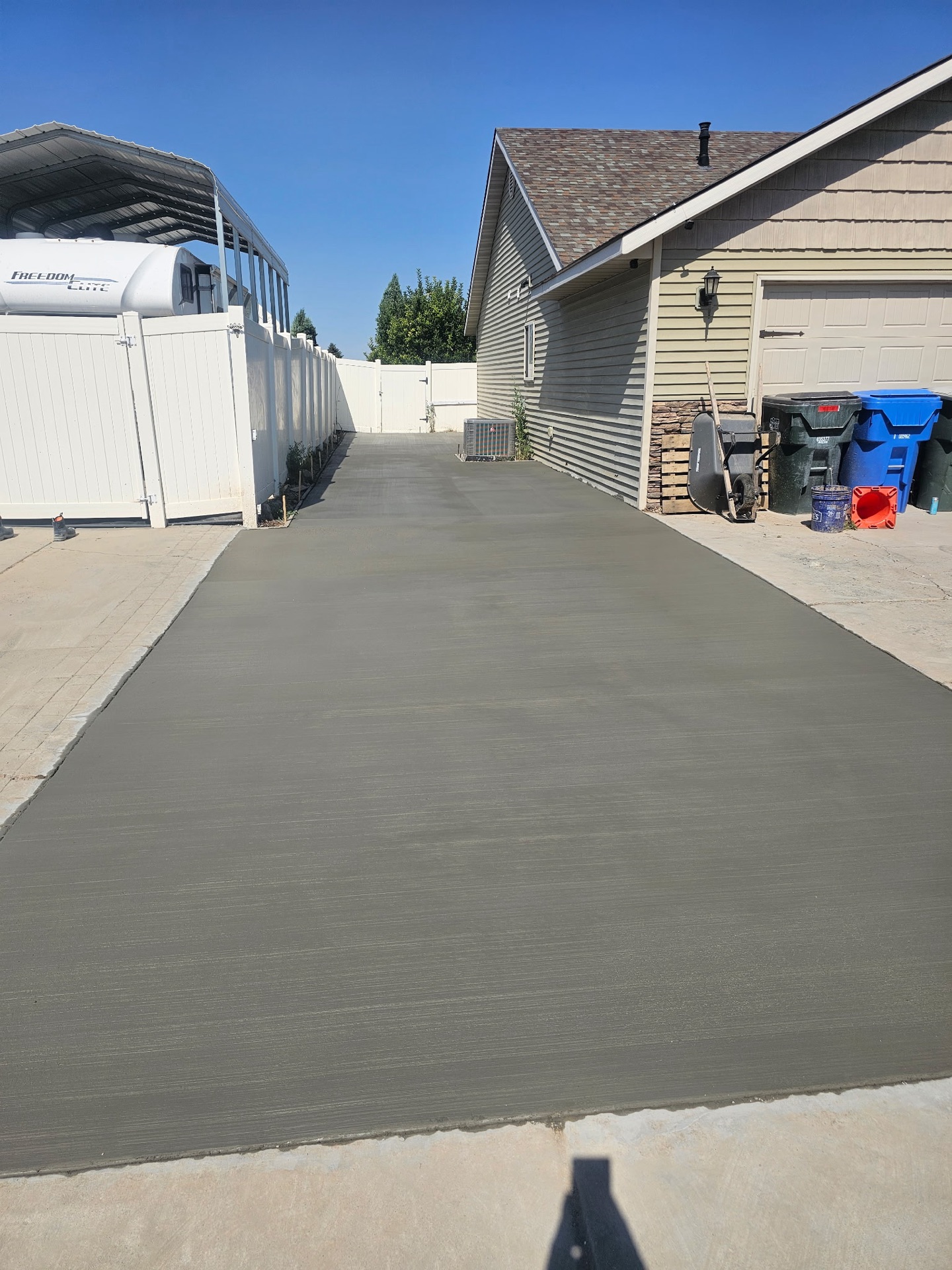
I run Skinner Customs out of Rigby, and the question I get before the truck has even pulled off the job is how long before you can drive on new concrete. Everybody wants the one number, and I understand why. Your car is parked on the street and the neighbor keeps asking about it.
Here is the honest answer. Foot traffic in a day or two. Your car in about a week. Anything heavy, and that includes a loaded trailer, a camper, a delivery truck or a dumpster, at 28 days. And in October or April around here, stretch all three of those.
Below is why those numbers are what they are, and what actually changes them on a job in Jefferson or Bonneville County.
Why 28 days is the number that matters
Concrete does not dry. It cures. Cement and water react chemically and keep reacting for weeks, and the slab is gaining strength the whole time. That reaction is why a slab can look finished on day two and still be nowhere near able to carry a truck.
The code puts a clock on it. The 2018 IRC as adopted in Idaho sets minimum strength in Table R402.2, and the footnote on that table is the part people never see:
“Strength at 28 days psi.”
Every strength number in the code is measured at 28 days. So when I tell you the mix is 4,000 PSI, I am telling you what it will be at 28 days, not what it is on Thursday afternoon. Concrete typically has a majority of that strength inside the first week and keeps climbing after, which is exactly why a passenger car at seven days is fine and a concrete truck at seven days is not.
That same code section is also where our climate shows up. Table R402.2 requires 3,500 PSI for garage floor slabs, porches and steps exposed to the weather in a severe weathering area, and it requires the concrete be air entrained:
“Concrete shall be air-entrained. Total air content (percent by volume of concrete) shall be not less than 5 percent or more than 7 percent.”
Air entrainment is microscopic bubbles in the mix that give freezing water somewhere to expand. It is not optional here, and it is one of the quiet differences between a slab that still looks good in fifteen years and one that starts flaking in five.
The timeline I give people
Day one. Stay off it. The finish is still soft enough to mark, and a footprint or a dog print is permanent. This is also when I do not want anybody setting a hose on it or washing a car next to it.
Day two to three. Walk on it. Normal foot traffic, no dragging furniture, no bikes with kickstands, no pressure washing.
Day seven or so. Park a car or a pickup on it. Pull straight in and straight out, do not crank the wheel while sitting still, and keep off the outside edges. Edges and corners are the weakest part of any slab because there is nothing beside them holding the load.
Day 28. Everything else. Trailers, campers, the fifth wheel, a delivery truck, a dumpster for a project. If somebody wants to drop a loaded dumpster on a new driveway, I ask them to put plywood under the wheels even after 28 days, because a dumpster concentrates all its weight on four small points.
Those are the warm weather numbers. A pour at 40 degrees is a different job.
What cold weather does to the wait
The chemical reaction that cures concrete slows down as it gets colder, and in Eastern Idaho that matters from roughly mid October through April. Cold concrete gains strength slower, so every number above gets longer. I plan protection into those pours with blankets, and sometimes with hot water or an accelerator in the mix, and I still tell the homeowner to wait longer than they would in July.
If a slab freezes before it has gained enough strength, the damage is permanent and it shows up as surface failure later. That is not something a sealer fixes.
This is also why I would rather pour your driveway in September than talk you into a November pour because the schedule had a hole in it.
Things that shorten a slab’s life in its first winter
A few habits do more damage in the first six months than the next ten years.
De-icing salt. Do not put it on a slab in its first winter. Any of it. A new surface has not finished hardening and salt accelerates the freeze thaw cycle that causes scaling. Sand gives you traction without the chemistry. After the first winter, I would still rather you use sand.
Standing water at the edges. Water that pools against a new slab, especially where a downspout dumps, works into the edge and freezes there. Get the downspout extended past the concrete.
Early sealing. A sealer on green concrete can trap moisture that still needs to leave. I give a new slab time before sealing it, and in our freeze thaw climate sealing is worth doing on the right schedule, not the fastest one.
Turning the wheel while parked. Power steering on a stationary car twists a lot of force into one spot. On a young slab that is how you get a scuff you cannot sand out.
What is actually under there matters more than the wait
I will say this because it is the part nobody asks about. How long you stay off a new slab matters far less than what is underneath it.
Four inches of clean compacted gravel base, built in lifts on questionable soil. Rebar, number three or number four on an eighteen inch grid, not wire mesh, because mesh gets stepped on during the pour and ends up at the bottom of the slab doing nothing. A 4,000 PSI minimum mix for our freeze thaw cycles. Control joints cut at the right spacing and depth so the slab cracks where we told it to.
Do those four things and your driveway will outlast the house’s first roof. Skip them and no amount of patience in week one saves it.
Frequently asked questions
Can I walk on new concrete the next day?
Usually yes, carefully, on normal flatwork in warm weather. The surface is hard enough that you will not leave a print, but it is nowhere near full strength. No pressure washing, no dragging anything across it.
Can I park on new concrete after a week?
A car or a half ton pickup, generally yes in summer. Pull straight in, stay off the edges, and do not turn the wheel while stopped. Wait the full 28 days for anything heavier, and longer if the pour was cold.
Does concrete cure faster in hot weather?
It gains early strength faster, but hot and windy is harder to finish and more likely to crack from rapid moisture loss. Hot weather pours need their own protection, usually curing compound and timing the pour early in the day. Faster is not the same as better.
How long until I can seal a new driveway?
Later than most people want. A new slab needs time before a sealer goes on, and putting one on too early can trap moisture in the concrete. The one thing I will say flatly is to keep de-icing salt off it through the first winter either way.
Why does my neighbor’s contractor say three days and you say 28?
We are probably answering different questions. Three days is roughly when you can walk on it. Twenty eight days is when the code says the mix has reached its specified strength. If somebody is telling you to park a loaded trailer on a four day old slab, that is not a shortcut, that is somebody else’s problem later.
Before you pour, ask what is going under it
If you are getting bids on a driveway, patio or shop slab in Rigby, Idaho Falls, Rexburg, Ammon or Shelley, ask every bidder three things: how thick, what is the base and how is it compacted, and rebar or mesh. The answers tell you more about how long that slab lasts than anything about the finish.
Need concrete work in Eastern Idaho? Call Zach at Skinner Customs at (208) 390-5794 or start at skinner-customs.com.
Content produced in partnership with S4 Media, marketing partner of SwagerBuilds LLC.