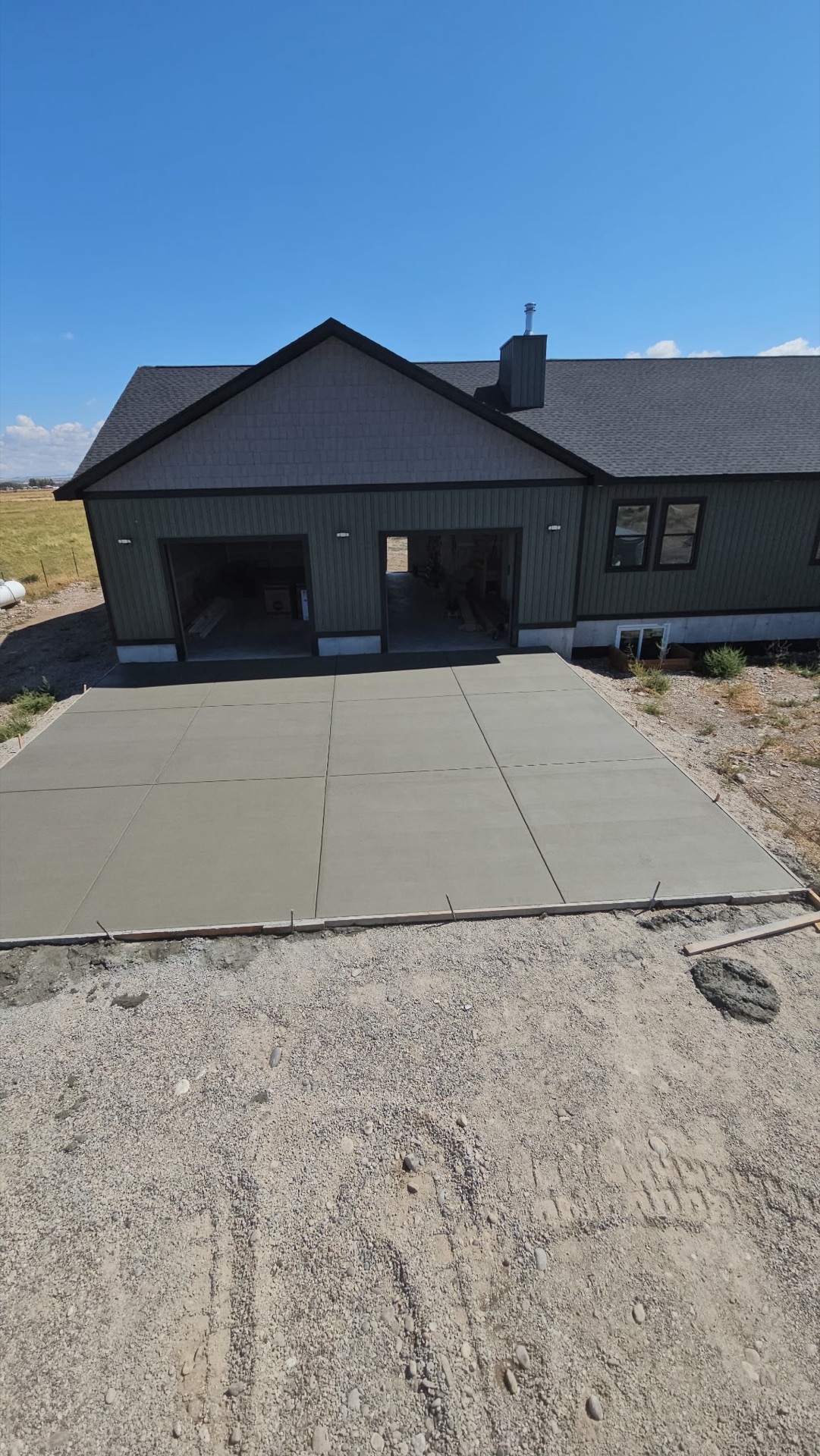
The cost to replace a concrete driveway in Eastern Idaho runs $10 to $17 per square foot in 2026 with the old slab removed and hauled. On a standard 20 x 60 two-car drive — 1,200 square feet — that is $12,000 to $20,400. Tear-out is $2 to $4 per square foot of that; the new pour is $8 to $13.
I run Skinner Customs out of Rigby, and replacement drives are a bigger share of our flatwork every year, because a lot of concrete poured in Rigby, Idaho Falls, Ammon, and Rexburg in the 1990s and early 2000s is now 25 to 30 winters old. Before you spend that money, it is worth knowing whether you actually need to, and why the first one failed — because if you replace the slab without fixing the reason, you buy the same problem again.
Replacement cost by driveway size
| Driveway size | Square footage | Replacement installed |
|---|---|---|
| One-car (12 x 30) | 360 sq ft | $3,600 – $6,120 |
| Two-car (20 x 30) | 600 sq ft | $6,000 – $10,200 |
| Two-car standard (20 x 60) | 1,200 sq ft | $12,000 – $20,400 |
| Three-car with apron (30 x 60) | 1,800 sq ft | $18,000 – $30,600 |
| Long rural drive (12 x 200) | 2,400 sq ft | $24,000 – $40,800 |
What moves you inside that range:
- Thickness. Standard residential is 4 inches. Every extra inch is about $1.50 to $2.50 per square foot. If you park a diesel, a fifth wheel, or a boat trailer, price 5 or 6 inches now.
- How much rebar is in the old slab. A mesh-and-gravel driveway from 1998 breaks out fast. A properly reinforced slab takes longer and costs more to remove.
- Access. If a dump trailer and a ready-mix truck can both get to the work, removal is cheap. Backyard slabs, narrow side yards, and gated drives cost more because the material moves by machine in small bites or by hand.
- Grade and drainage work. If the reason the old drive failed was water, fixing it is part of the job, not an upsell.
- Decorative finish. Integral color adds $1.50 to $3 per square foot. Stamped work runs $14 to $22 installed.
Repair or replace: how to tell
Not every bad-looking driveway needs to come out. Here is how I sort it on a walk-through.
Replace it when:
- Panels have settled or heaved enough to create a lip you can catch a toe or a snowplow blade on
- The surface is scaling or spalling over most of its area — flaking off in layers, exposing aggregate
- Cracks are wide (over about a quarter inch), numerous, and have vertical offset between the two sides
- The slab is cracked into pieces smaller than about 3 feet across, which means it has lost its structure
- It is under 4 inches thick and you need it to carry more than it was built for
Repair or resurface it when:
- Cracks are narrow, stable, and mostly at or near the joints
- One or two panels are bad and the rest is sound — those panels can be cut out and replaced
- The surface is sound but stained or dull
- A single corner has settled, which a slab-jacking outfit can sometimes lift back for far less than replacement
The honest version: a driveway with a handful of tight cracks and no offset has years left. A driveway that flakes under a shovel or rocks when you drive on it does not.
Why the old one failed
This is the part most replacement bids skip, and it is the part that decides whether the new slab lasts 30 years or 10.
Surface scaling — the flaking that turns a smooth drive into a rough, pitted one — is the most common failure I see in this climate, and it is almost never bad luck. The National Ready Mixed Concrete Association’s bulletin CIP 2, Scaling Concrete Surfaces, lists the causes plainly: too little entrained air, concrete without enough strength to resist water penetration, deicing chemicals applied too early, poor finishing, and insufficient curing. For freeze-thaw exposure with deicers, it specifies 4,000 psi concrete and about 6 percent total air content for common aggregate sizes.
That matches what we dig out. The failed drives around here were usually poured thin, on light or uncompacted base, with a low-strength mix, salted their first winter, and never cured properly. Any one of those alone is survivable. Three together is a 15-year driveway.
The structural failures — settlement, heaving, cracking into pieces — are almost always base and water. Topsoil never stripped, fill never compacted in lifts, an irrigation line running under the slab, or a downspout dumping at the edge of the concrete.
What a replacement should include
If you are spending five figures on the same square footage twice, the second one gets built right:
- Strip and rebuild the base. Old gravel that has been sitting under a failed slab for 25 years gets reworked and recompacted, not just leveled. Minimum 4 inches of compacted gravel, in lifts, deeper on soft or irrigated ground.
- 4,000 PSI air-entrained mix. Non-negotiable in a freeze-thaw climate, and it is what the NRMCA guidance above calls for.
- #3 or #4 rebar on an 18-inch grid. Every slab, every time. Wire mesh is the low-bid shortcut. It is supposed to sit mid-slab and it ends up walked to the bottom during the pour, which means it does nothing.
- Joints laid out before the pour, not after. Contraction joints cut to at least a quarter of the slab depth, panels kept close to square, isolation joints where the drive meets the garage slab, the walk, and the apron.
- Drainage fixed. Slope away from the garage and the house. If the old drive pooled, the new one gets regraded, not repoured at the same elevation.
- Real curing. A curing compound or wet cover, and no deicers the first winter. Sand for traction instead.
Our flatwork pricing starts at $8 per square foot for a plain pour, and a replacement runs above that because tear-out and haul-off are real costs. A replacement quoted at the price of a new pour on bare ground means the tear-out is coming out of something else — usually the base or the reinforcement.
Timing a replacement in Eastern Idaho
Spring through fall is the window. Two practical notes for this area:
You lose the driveway for about a week. Tear-out and base work are a day or two, the pour is a day, and you stay off it for a week with vehicles — longer for anything heavy. Plan parking before we start.
Fall pours are fine, and often our best-quality work, as long as the slab has time to gain strength before hard freezes and before salt lands on it. What I will not do is pour a driveway in November and hand you a slab that gets deiced at three weeks old. That is how the last one started failing.
Frequently asked questions
How much does it cost to replace a concrete driveway in 2026?
In Eastern Idaho, $10 to $17 per square foot with removal included. A 1,200-square-foot two-car drive is $12,000 to $20,400 depending on thickness, access, and site work.
How much of that is tear-out?
Removal and haul-off is $2 to $4 per square foot, depending on slab thickness, reinforcement, and access.
Can I pour new concrete over an old driveway instead?
Sometimes, but only if the existing slab is structurally sound and the added height does not create a problem at the garage door or the street. If the old slab is cracked into pieces or heaving, an overlay just cracks along with it.
How long does a concrete driveway last in Idaho?
Built right — 4,000 PSI air-entrained mix, rebar, compacted base, proper curing, no early salt — 30 years or more. Built thin on bad base and salted young, 10 to 15.
Is it worth replacing just the bad panels?
Often, yes. If the rest of the slab is sound, cutting out and replacing individual panels costs a fraction of a full replacement. Expect a visible color difference between new and weathered concrete.
What deicer is safe on a new driveway?
None for the first winter. After that, calcium chloride and sodium chloride are acceptable on concrete. Never use ammonium-based or magnesium-based products, which chemically attack the surface.
Get a replacement number
Send photos of the driveway — the whole run plus close-ups of the worst areas — the approximate dimensions, and a note on where trucks can get in. I will tell you whether it needs replacing, whether partial panel replacement gets you there for less, and what the real number is.
Need concrete work in Eastern Idaho? Call Zach at Skinner Customs at (208) 390-5794 or start at skinner-customs.com.
Content produced in partnership with S4 Media, marketing partner of SwagerBuilds LLC.
Leave a Reply