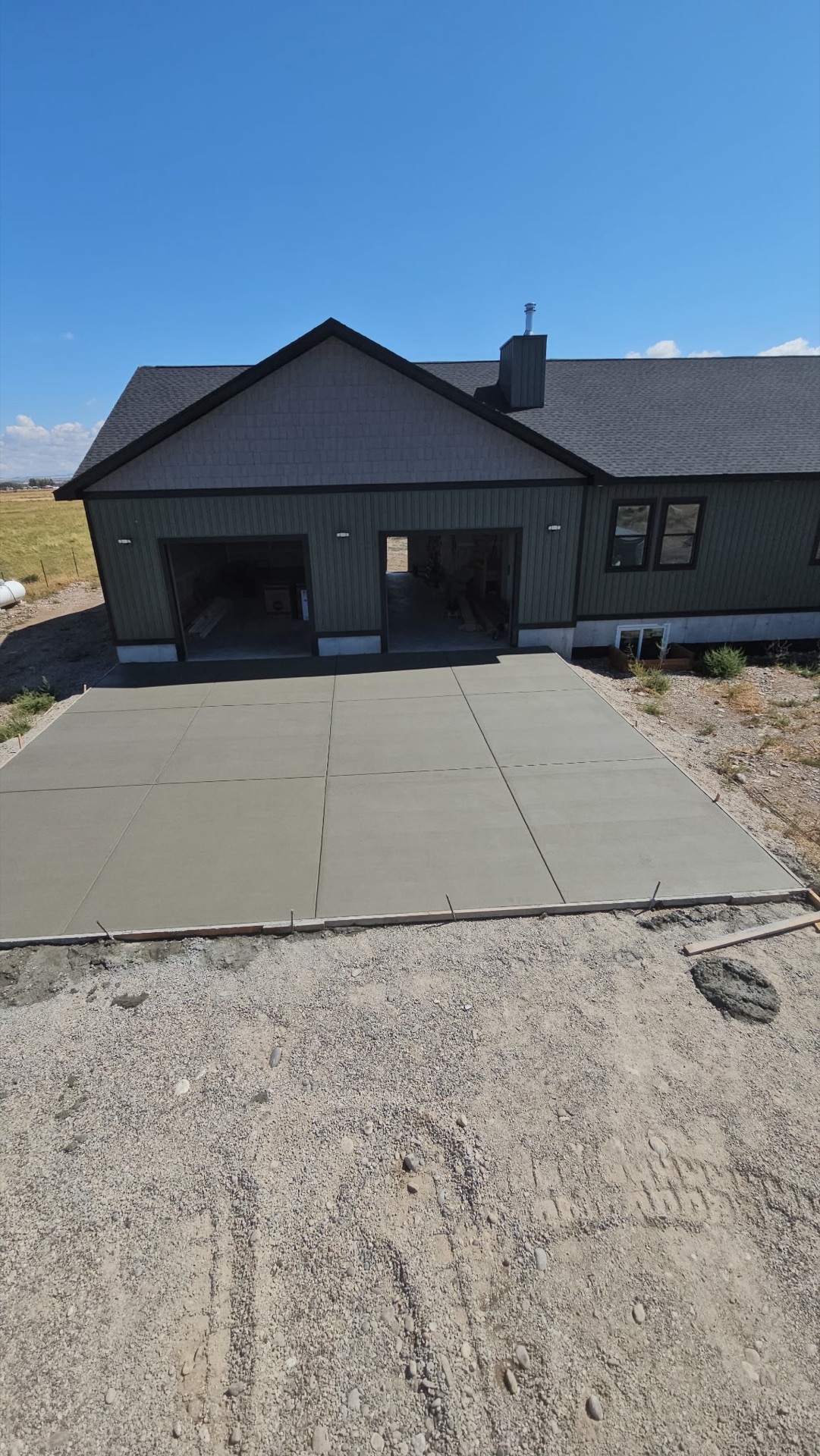
Category: Cost Guides

  • Cost to Replace a Concrete Driveway in 2026 (Eastern Idaho Numbers)

    Cost to Replace a Concrete Driveway in 2026 (Eastern Idaho Numbers)

    The cost to replace a concrete driveway in Eastern Idaho runs $10 to $17 per square foot in 2026 with the old slab removed and hauled. On a standard 20 x 60 two-car drive — 1,200 square feet — that is $12,000 to $20,400. Tear-out is $2 to $4 per square foot of that; the new pour is $8 to $13.

    I run Skinner Customs out of Rigby, and replacement drives are a bigger share of our flatwork every year, because a lot of concrete poured in Rigby, Idaho Falls, Ammon, and Rexburg in the 1990s and early 2000s is now 25 to 30 winters old. Before you spend that money, it is worth knowing whether you actually need to, and why the first one failed — because if you replace the slab without fixing the reason, you buy the same problem again.

    Replacement cost by driveway size

    Driveway size Square footage Replacement installed
    One-car (12 x 30) 360 sq ft $3,600 – $6,120
    Two-car (20 x 30) 600 sq ft $6,000 – $10,200
    Two-car standard (20 x 60) 1,200 sq ft $12,000 – $20,400
    Three-car with apron (30 x 60) 1,800 sq ft $18,000 – $30,600
    Long rural drive (12 x 200) 2,400 sq ft $24,000 – $40,800

    What moves you inside that range:

    • Thickness. Standard residential is 4 inches. Every extra inch is about $1.50 to $2.50 per square foot. If you park a diesel, a fifth wheel, or a boat trailer, price 5 or 6 inches now.
    • How much rebar is in the old slab. A mesh-and-gravel driveway from 1998 breaks out fast. A properly reinforced slab takes longer and costs more to remove.
    • Access. If a dump trailer and a ready-mix truck can both get to the work, removal is cheap. Backyard slabs, narrow side yards, and gated drives cost more because the material moves by machine in small bites or by hand.
    • Grade and drainage work. If the reason the old drive failed was water, fixing it is part of the job, not an upsell.
    • Decorative finish. Integral color adds $1.50 to $3 per square foot. Stamped work runs $14 to $22 installed.

    Repair or replace: how to tell

    Not every bad-looking driveway needs to come out. Here is how I sort it on a walk-through.

    Replace it when:

    • Panels have settled or heaved enough to create a lip you can catch a toe or a snowplow blade on
    • The surface is scaling or spalling over most of its area — flaking off in layers, exposing aggregate
    • Cracks are wide (over about a quarter inch), numerous, and have vertical offset between the two sides
    • The slab is cracked into pieces smaller than about 3 feet across, which means it has lost its structure
    • It is under 4 inches thick and you need it to carry more than it was built for

    Repair or resurface it when:

    • Cracks are narrow, stable, and mostly at or near the joints
    • One or two panels are bad and the rest is sound — those panels can be cut out and replaced
    • The surface is sound but stained or dull
    • A single corner has settled, which a slab-jacking outfit can sometimes lift back for far less than replacement

    The honest version: a driveway with a handful of tight cracks and no offset has years left. A driveway that flakes under a shovel or rocks when you drive on it does not.

    Why the old one failed

    This is the part most replacement bids skip, and it is the part that decides whether the new slab lasts 30 years or 10.

    Surface scaling — the flaking that turns a smooth drive into a rough, pitted one — is the most common failure I see in this climate, and it is almost never bad luck. The National Ready Mixed Concrete Association’s bulletin CIP 2, Scaling Concrete Surfaces, lists the causes plainly: too little entrained air, concrete without enough strength to resist water penetration, deicing chemicals applied too early, poor finishing, and insufficient curing. For freeze-thaw exposure with deicers, it specifies 4,000 psi concrete and about 6 percent total air content for common aggregate sizes.

    That matches what we dig out. The failed drives around here were usually poured thin, on light or uncompacted base, with a low-strength mix, salted their first winter, and never cured properly. Any one of those alone is survivable. Three together is a 15-year driveway.

    The structural failures — settlement, heaving, cracking into pieces — are almost always base and water. Topsoil never stripped, fill never compacted in lifts, an irrigation line running under the slab, or a downspout dumping at the edge of the concrete.

    What a replacement should include

    If you are spending five figures on the same square footage twice, the second one gets built right:

    • Strip and rebuild the base. Old gravel that has been sitting under a failed slab for 25 years gets reworked and recompacted, not just leveled. Minimum 4 inches of compacted gravel, in lifts, deeper on soft or irrigated ground.
    • 4,000 PSI air-entrained mix. Non-negotiable in a freeze-thaw climate, and it is what the NRMCA guidance above calls for.
    • #3 or #4 rebar on an 18-inch grid. Every slab, every time. Wire mesh is the low-bid shortcut. It is supposed to sit mid-slab and it ends up walked to the bottom during the pour, which means it does nothing.
    • Joints laid out before the pour, not after. Contraction joints cut to at least a quarter of the slab depth, panels kept close to square, isolation joints where the drive meets the garage slab, the walk, and the apron.
    • Drainage fixed. Slope away from the garage and the house. If the old drive pooled, the new one gets regraded, not repoured at the same elevation.
    • Real curing. A curing compound or wet cover, and no deicers the first winter. Sand for traction instead.

    Our flatwork pricing starts at $8 per square foot for a plain pour, and a replacement runs above that because tear-out and haul-off are real costs. A replacement quoted at the price of a new pour on bare ground means the tear-out is coming out of something else — usually the base or the reinforcement.

    Timing a replacement in Eastern Idaho

    Spring through fall is the window. Two practical notes for this area:

    You lose the driveway for about a week. Tear-out and base work are a day or two, the pour is a day, and you stay off it for a week with vehicles — longer for anything heavy. Plan parking before we start.

    Fall pours are fine, and often our best-quality work, as long as the slab has time to gain strength before hard freezes and before salt lands on it. What I will not do is pour a driveway in November and hand you a slab that gets deiced at three weeks old. That is how the last one started failing.

    Frequently asked questions

    How much does it cost to replace a concrete driveway in 2026?

    In Eastern Idaho, $10 to $17 per square foot with removal included. A 1,200-square-foot two-car drive is $12,000 to $20,400 depending on thickness, access, and site work.

    How much of that is tear-out?

    Removal and haul-off is $2 to $4 per square foot, depending on slab thickness, reinforcement, and access.

    Can I pour new concrete over an old driveway instead?

    Sometimes, but only if the existing slab is structurally sound and the added height does not create a problem at the garage door or the street. If the old slab is cracked into pieces or heaving, an overlay just cracks along with it.

    How long does a concrete driveway last in Idaho?

    Built right — 4,000 PSI air-entrained mix, rebar, compacted base, proper curing, no early salt — 30 years or more. Built thin on bad base and salted young, 10 to 15.

    Is it worth replacing just the bad panels?

    Often, yes. If the rest of the slab is sound, cutting out and replacing individual panels costs a fraction of a full replacement. Expect a visible color difference between new and weathered concrete.

    What deicer is safe on a new driveway?

    None for the first winter. After that, calcium chloride and sodium chloride are acceptable on concrete. Never use ammonium-based or magnesium-based products, which chemically attack the surface.

    Get a replacement number

    Send photos of the driveway — the whole run plus close-ups of the worst areas — the approximate dimensions, and a note on where trucks can get in. I will tell you whether it needs replacing, whether partial panel replacement gets you there for less, and what the real number is.

    Need concrete work in Eastern Idaho? Call Zach at Skinner Customs at (208) 390-5794 or start at skinner-customs.com.


    Content produced in partnership with S4 Media, marketing partner of SwagerBuilds LLC.

  • Pole Barn Concrete Slab Cost in Eastern Idaho (2026): What Changes When the Building Goes Up First

    Pole Barn Concrete Slab Cost in Eastern Idaho (2026): What Changes When the Building Goes Up First

    Pole barn concrete slab cost in Eastern Idaho runs $10 to $16 per square foot installed in 2026, the same range as any well-built shop floor. A 40 x 60 pole barn, 2,400 square feet, lands between $24,000 and $38,400 depending on thickness and what you drive on it. What makes a pole barn different is not the price per foot. It is everything that happens because the building is usually standing before the concrete shows up.

    I run Skinner Customs out of Rigby, and pole barn slabs are a big part of what we pour between Rexburg and Shelley. Most of the problems I get called to look at on post-frame buildings were not concrete problems at the pour. They were planning problems that turned into concrete problems.

    2026 pole barn slab pricing

    These numbers assume a 4,000 PSI mix, rebar reinforcement, compacted gravel base, a vapor barrier, and a standard finish:

    Building size Square footage 5-inch slab 6-inch slab
    30 x 40 1,200 sq ft $12,000 – $15,600 $14,400 – $19,200
    40 x 60 2,400 sq ft $24,000 – $31,200 $28,800 – $38,400
    50 x 80 4,000 sq ft $40,000 – $52,000 $48,000 – $64,000

    If you need the full breakdown on thickness by equipment load, we covered it in our shop slab cost guide. The short version: 5 inches for trucks, trailers, and hobby use, 6 inches for tractors, skid steers, and lifts.

    What those tables do not show are the post-frame costs that land on top: pumping, the apron, and anything that has to be fixed about the site before we can pour.

    Building first, slab second: why the order matters

    On most pole barns around here, the posts, trusses, roof, and walls go up first, and the slab gets poured inside the finished shell. There are real advantages. The roof keeps rain and snow off fresh concrete, the building defines the slab edges, and the pour is not racing the weather.

    The trade-off is access. A ready-mix truck cannot drive into a building. If the chute can reach every corner from the overhead door, great. If it cannot, we are pumping, and pump-truck day rates in Eastern Idaho run $850 to $1,400. On a 40 x 60 with one 12-foot door on the gable end, the back corners are a long way from a chute.

    What to do about it: put the biggest overhead door where a truck can back straight up to it, and if you have a choice, put a door on the long side too. Tell the building crew to leave the interior liner, insulation, and any framed rooms until the slab is in. Pouring and finishing around finished walls is slower, messier, and costs more.

    The posts and the slab have to be planned together

    In a post-frame building, the posts carry the roof and walls. The slab is a floor that sits inside them. That changes a few things:

    Separate the slab from the posts. Concrete shrinks as it cures and moves with temperature. If it is poured tight against a post with nothing between them, it has nowhere to go and it cracks at the post. An isolation joint around each post lets the slab move on its own.

    Line the control joints up with the posts where you can. A slab is going to crack where it wants to, and posts are natural stress points. Joints laid out on the post grid give those cracks a straight, planned place to happen.

    Check the skirt board before the pour, not after. The treated splash or skirt board at the bottom of the walls usually becomes the slab edge. If it was set out of level or at the wrong height, the slab will be too. Five minutes with a laser before we set up is a lot cheaper than a floor that drains toward the back wall.

    Site prep on farm ground

    Most pole barns in this area go up on old farm ground, and that is where the quiet failures start.

    Strip the topsoil. Organic soil compresses and rots. Gravel dumped on top of it settles unevenly, and the slab follows.

    Compacted gravel base, 4 inches minimum. Placed and compacted in lifts, and deeper where the ground is soft or has irrigation history. If the building crew brought in fill to level the pad, find out what it was and whether it was compacted.

    Vapor barrier. If the building is enclosed and you are storing anything you care about, put a vapor barrier under the slab. Ground moisture moving up through the concrete causes condensation, rust, and musty storage, and it will push a floor coating off later if you ever want one.

    Reinforcement: rebar, not mesh

    Every slab we pour gets #3 or #4 rebar on an 18-inch grid. Wire mesh is the low-bid shortcut. It is supposed to sit mid-slab, but it gets walked down to the bottom during the pour and ends up doing nothing. On a floor carrying jack stands, loaded trailers, and tractor tires, that matters.

    Our flatwork pricing starts at $8 per square foot, and pole barn slabs run above that because of thickness and reinforcement. A pole barn slab bid well under that in this market means something above got cut.

    Don’t forget the apron

    The concrete outside the overhead door takes more abuse than anything inside the building. It carries every wheel load in and out, it sits in snowmelt all winter, and it catches the road salt dripping off your truck.

    Plan the apron with the slab, not as an afterthought. It should slope away from the door, have a thickened edge where the tires cross, and ideally be poured the same day or tied to the slab so it does not heave independently. A quarter inch per foot of fall toward the door inside the building sends snowmelt out instead of pooling at the back wall.

    Decide on heat before the pour

    If there is any chance you want a heated pole barn, run in-floor radiant PEX before the concrete goes down. It adds roughly $3 to $6 per square foot at pour time. Retrofitting heat into a finished floor means an overlay or a tear-out. For a heated building, plan insulation under the slab and at the slab edge too, because that edge is where heat escapes to cold ground.

    The National Frame Building Association publishes post-frame construction resources that are worth reading before you order a building package, especially on how the building and the floor get detailed together.

    Frequently asked questions

    How much does a concrete slab cost for a 40 x 60 pole barn in Eastern Idaho? About $24,000 to $38,400 installed in 2026, depending on thickness, reinforcement, and site conditions. A 6-inch slab runs $28,800 to $38,400.

    Should the slab go in before or after the pole barn is built? Usually after the shell is up. The roof protects the pour and the walls define the edges. Just plan door placement for truck access and hold off on interior finishes until the floor is in.

    How thick should a pole barn slab be? 5 inches for trucks, trailers, and general use. 6 inches for tractors, skid steers, and lifts. Heavy equipment or commercial use needs an engineered slab.

    Do I need a vapor barrier under a pole barn slab? For an enclosed building used for storage, a shop, or anything heated, yes. It keeps ground moisture from coming up through the floor.

    Why does my pole barn slab crack at the posts? Usually because the slab was poured tight against the posts with no isolation joint, or the control joints were not laid out with the post grid.

    Get a pole barn slab bid

    Send the building size, door locations, what you plan to park or run on the floor, and whether the shell is up yet, and I will tell you what it takes.

    Need concrete work in Eastern Idaho? Call Zach at Skinner Customs at (208) 390-5794 or start at skinner-customs.com.


    Content produced in partnership with S4 Media, marketing partner of SwagerBuilds LLC.

  • Concrete Driveway Cost in Rigby Idaho (2026) — Real Numbers from a Local Contractor

    Concrete Driveway Cost in Rigby Idaho (2026) — Real Numbers from a Local Contractor

    The concrete driveway cost in Rigby Idaho for 2026 runs $7 to $13 per square foot for a standard 4-inch pour, which puts a typical 20 x 60 two-car drive at roughly $9,800 to $18,200 installed. That range is wider than a homeowner expects, and the reason is the same reason contractors quote such different numbers: what’s actually under the slab matters more than the concrete itself.

    I run Skinner Customs out of Rigby. We pour driveways, flatwork, foundations, and shop slabs across Jefferson, Bonneville, and Madison counties. This is the honest breakdown of what a driveway costs here, why it costs that, and what to check on a bid before you sign it.

    What’s included at that per-square-foot price

    The $7 to $13/sq ft range assumes:

    • 4-inch thick slab (standard residential)
    • 4,000 PSI concrete mix — appropriate for our freeze-thaw cycles
    • Wire mesh or fiber reinforcement
    • Standard broom finish
    • 4-inch compacted gravel base
    • Basic tear-out of an existing slab, if any
    • Standard site access — truck can back into place

    At the low end ($7) you’re getting a straight rectangular pour on a flat site with good access. At the high end ($13) you’re paying for tighter access, more excavation, thicker slab, or a decorative finish. Custom color, stamped pattern, or exposed aggregate can add $4 to $9 per square foot on top.

    Real cost by driveway size in Rigby

    Driveway sizeSquare footage2026 installed cost
    One-car (12 x 30)360 sq ft$2,520 – $4,680
    Two-car (20 x 30)600 sq ft$4,200 – $7,800
    Two-car standard (20 x 60)1,200 sq ft$9,800 – $18,200
    Three-car w/ apron (30 x 60)1,800 sq ft$12,600 – $23,400
    Long rural drive (12 x 200)2,400 sq ft$16,800 – $31,200

    These are ranges for standard broom finish. Decorative work sits on top of these numbers, not inside them.

    What drives the number up

    Subgrade prep. Half the honest driveways I’ve torn out failed because the base wasn’t right. Rigby sits on some poorly-drained clay pockets and old irrigation-affected ground, especially south and west of downtown. A cheap bid usually skips the extra 2-3 inches of imported gravel and the second round of compaction. That saves them $600-$1,200 on the bid and costs you a crack pattern in three winters.

    Slab thickness. Standard residential is 4 inches. If you’re parking a diesel truck, a boat trailer, or planning to drive equipment on it, you want 5 or 6 inches. The upcharge is roughly $1.50-$2.50 per square foot for every extra inch.

    Reinforcement. Wire mesh is standard. Rebar (#3 or #4 on 18-inch grid) is $0.80-$1.30 per square foot extra. For a driveway that’ll see heavy loads or that sits over questionable subgrade, rebar is worth it.

    Site access. If the truck can’t back within the length of a standard chute (about 16 feet), we’re pumping. Pump-truck day-rate in Eastern Idaho runs $850-$1,400 depending on size. That’s not a scam; it’s a real cost. But the bid should call it out separately.

    Tear-out. Removing and hauling an existing slab typically adds $2-$4 per square foot depending on thickness and how much rebar is in it.

    Concrete color and finish. Integral color is roughly $1.50-$3 per square foot extra. Stamped concrete adds $6-$12 per square foot on top of the base. Exposed aggregate is in between.

    Why Rigby costs less than Driggs or Jackson

    Concrete pricing in Eastern Idaho has a strong distance-from-batch-plant multiplier. Rigby is close to plants in Idaho Falls and Rexburg, so our per-yard concrete cost is $155-$175 delivered. In Driggs you’re paying $205-$245 per yard by the time the truck gets over Pine Creek. In Jackson it’s higher again. That’s why a driveway that costs $12,000 in Rigby can cost $18,000+ in Teton Valley for the same square footage.

    If you’re building a custom home in Rigby and comparing your foundation and flatwork bids against numbers a friend got in Teton Valley, that’s why. It’s not that anyone is trying to gouge you — it’s the cost of concrete at the plant plus haul time. A trusted local builder like SwagerBuilds LLC — the custom home builder in Rigby we partner with on foundation and flatwork — sees the same delta on every full build across the valley.

    What a real Rigby driveway bid should include

    Before you sign a bid, make sure it names:

    1. Slab thickness (inches)
    2. Concrete PSI (should be 4,000 minimum in our climate)
    3. Reinforcement type (mesh vs. rebar vs. fiber, and spacing)
    4. Base prep — how much gravel, compacted in how many lifts
    5. Control-joint spacing and depth
    6. Curing method (wet cure, curing compound, or blanket)
    7. Whether they pull the permit and what the permit fee is
    8. Whether they haul out spoils or you dispose of them

    A bid that doesn’t name these things is asking you to trust that they’re doing them. Some contractors are. Some cut them. You want it in writing.

    Permits in Jefferson County

    For a residential driveway on your own lot in Jefferson County, a building permit is not required for the slab itself. If your driveway ties into a county road or a state highway, you need an approach permit from the Jefferson County Road & Bridge Department or the Idaho Transportation Department (ITD). Fees run $50-$200 depending on the approach type. If you’re inside Rigby city limits, check with Rigby City Public Works before pouring anything that touches the right-of-way.

    When to pour a driveway in Eastern Idaho

    The pour window in Rigby runs mid-April through mid-October for standard work. We pour in cold weather with the right admixtures, blankets, and heaters, but you’re paying $400-$900 extra for the accommodations. Best-value pours in our climate are May, June, and September — the ground is workable, the mix cures well, and the weather isn’t fighting you.

    If you’re planning a new home build, get your driveway on the schedule with your foundation contractor early. Coordinating the driveway pour with the foundation, the garage slab, and the front walk saves setup fees and gets you a better price per yard.

    What a driveway lasts in this climate

    A driveway poured right — 4,000 PSI, proper reinforcement, real base prep, control joints on 10-12 foot grid — should give you 30-40 years of service in Rigby’s climate before it needs meaningful attention. Sealing every 3-5 years adds life, especially at the joints. The failures I see driving around Jefferson County aren’t 25-year-old driveways giving out. They’re 6- to 10-year-old driveways where the base was skipped.

    FAQ

    How much does a 2-car concrete driveway cost in Rigby?
    A standard 20 x 60 two-car concrete driveway in Rigby costs $9,800 to $18,200 installed in 2026, depending on subgrade, slab thickness, and finish.

    Is concrete or asphalt cheaper for a driveway in Idaho?
    Asphalt is 20–35% cheaper upfront ($5–$8 per sq ft installed in Rigby) but needs seal-coating every 2–4 years and typically lasts 15–20 years. Concrete costs more upfront but lasts 30–40 years with minimal maintenance.

    Do I need a permit for a driveway in Jefferson County Idaho?
    Not for the slab itself if it’s entirely on your lot. If the driveway ties into a county or state road, you need an approach permit from Jefferson County Road & Bridge or ITD.

    How thick should a concrete driveway be?
    4 inches for standard passenger vehicles. 5 to 6 inches if you’re parking heavy trucks, RVs, or trailers.

    What’s the best time of year to pour a driveway in Rigby?
    May, June, and September are the best-value pour months. Ground is workable, curing conditions are ideal, and no cold-weather surcharges.


    Get a real bid from Skinner Customs

    Need a concrete driveway in Rigby, Idaho Falls, Rexburg, Ammon, or Shelley? Call (208) 390-5794 or start at skinner-customs.com. We bid it honest, pour it right, and we’re still here when you have a question three years later.


    Content produced in partnership with S4 Media, marketing partner of SwagerBuilds LLC — 4th-generation Eastern Idaho custom home builder.

    Sources

    • National Ready Mixed Concrete Association (NRMCA) — 2026 regional concrete pricing benchmarks
    • ACI 318 — structural concrete requirements
    • Jefferson County Road & Bridge Department — driveway approach permits
    • Idaho Transportation Department (ITD) — state highway approach standards