Stamped concrete patios in Idaho Falls run $14 to $22 per square foot installed in 2026. A 16 x 20 patio — 320 square feet, which is the size most people land on — comes in around $4,480 to $7,040. That is roughly double a plain broom-finish patio, and the gap catches people off guard.
I run Skinner Customs out of Rigby. We pour flatwork, foundations, and decorative concrete across Jefferson, Bonneville, and Madison counties, and stamped patios are a big share of what we do in Idaho Falls. Here is what the money actually buys, and where a cheap stamped bid goes wrong.
Why stamped costs roughly double plain concrete
A broom-finish patio is one crew, one pass, done. Stamped concrete is the same slab plus four more variables that all have to go right on the same afternoon.
- Integral color is mixed into the concrete at the plant. Adds $1.50 to $3 per square foot.
- Release color is the secondary tone broadcast on the surface before stamping. Adds $0.75 to $1.50.
- Stamping labor is the real cost. You need more hands on site during a narrow window, and every one of them has to know what they are doing.
- Sealing is not optional on stamped work. Budget $0.75 to $1.50 per square foot, and plan on resealing every two to three years.
The timing is what makes it hard. Concrete tells you when it is ready to stamp, and that window in Idaho Falls in July can be under thirty minutes. Stamp too early and the mats sink and distort. Stamp too late and you get a shallow, washed-out pattern that looks like a rubber floor mat. There is no fixing either one after the fact.
Real cost by patio size in Idaho Falls
| Patio size | Square footage | 2026 installed cost |
|---|---|---|
| Small (10 x 12) | 120 sq ft | $1,680 – $2,640 |
| Standard (12 x 16) | 192 sq ft | $2,690 – $4,220 |
| Common (16 x 20) | 320 sq ft | $4,480 – $7,040 |
| Large (20 x 24) | 480 sq ft | $6,720 – $10,560 |
| Wraparound w/ steps (700+) | 700 sq ft | $9,800 – $15,400 |
Steps, curved edges, and multiple pattern borders push toward the top of the range. A straight rectangle on a flat, accessible site sits near the bottom.
What is underneath matters more than the pattern
This is where the money hides, and it is the part nobody looks at on a bid.
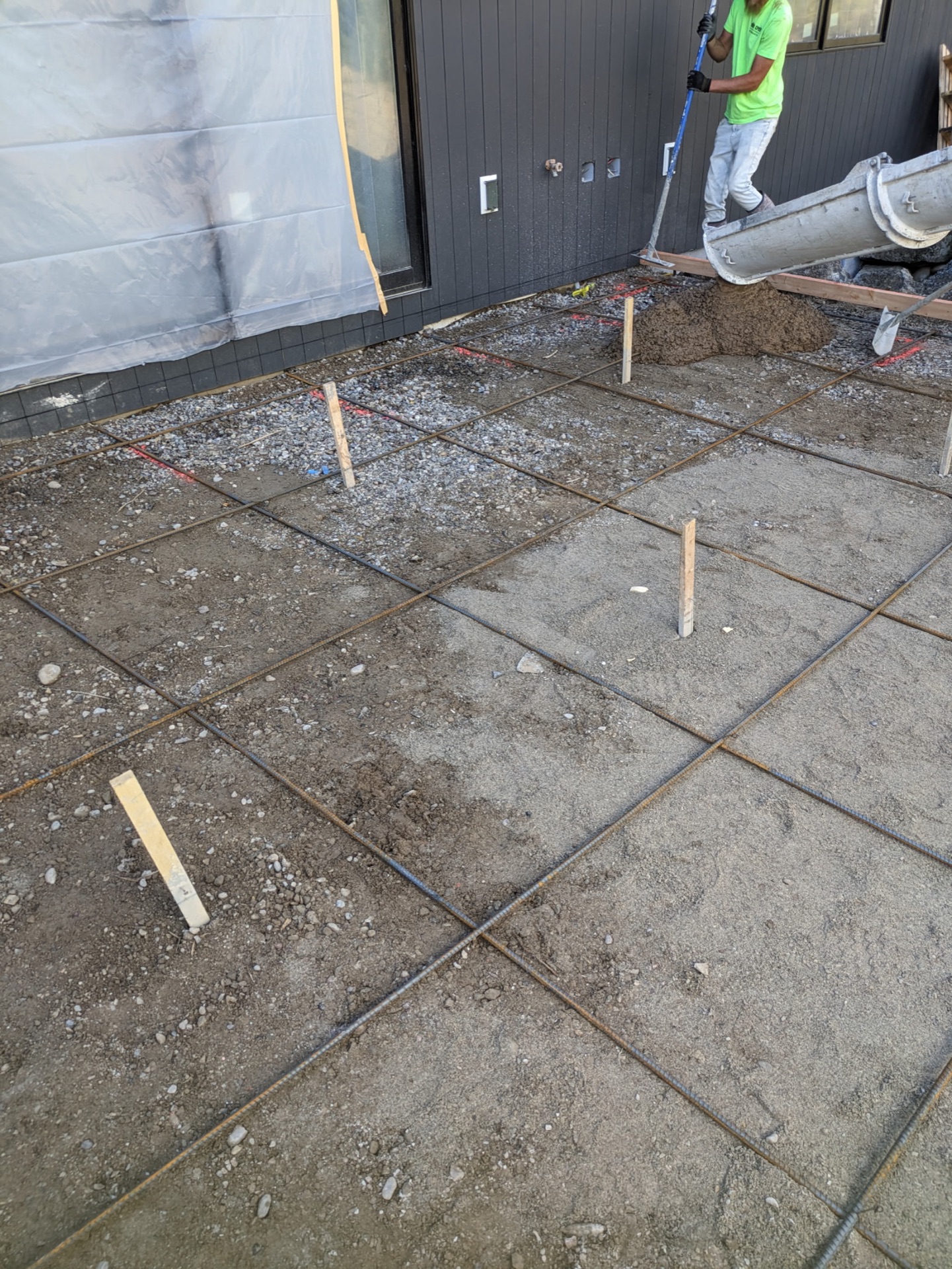
Base prep. Compacted gravel base, minimum 4 inches, and multiple lifts if the soil is questionable. Parts of Idaho Falls sit on old irrigation-affected ground and pockets of poorly drained clay. A patio poured on uncompacted native soil will move, and when a stamped slab moves the crack runs straight through your pattern where you cannot hide it.
Rebar, not wire mesh. Every Skinner Customs pour uses #3 or #4 rebar on an 18-inch grid. Wire mesh is the low-baller shortcut — it lifts out of position the moment concrete hits it and ends up sitting on the bottom of the slab doing nothing. On a stamped patio that failure is expensive, because you are not patching a decorative surface invisibly. Ever.
4,000 PSI minimum. Our freeze-thaw cycles are hard on concrete. A weaker mix on a surface that gets sealed, gets wet, and freezes is asking for surface spalling in year three.
Slab thickness. Four inches is standard for a patio. If you are setting a hot tub, tell your contractor before the pour, not after — that corner needs to be thicker and reinforced for the load.
If a stamped bid comes in under $12 per square foot in this market, something above got cut. Our flatwork floor is $8 per square foot for plain broom finish, and stamped work carries real added labor and material on top of that. A number well below the market is not a deal, it is a forecast.
Patterns that hold up here
Not every pattern wears the same way through an Eastern Idaho winter.
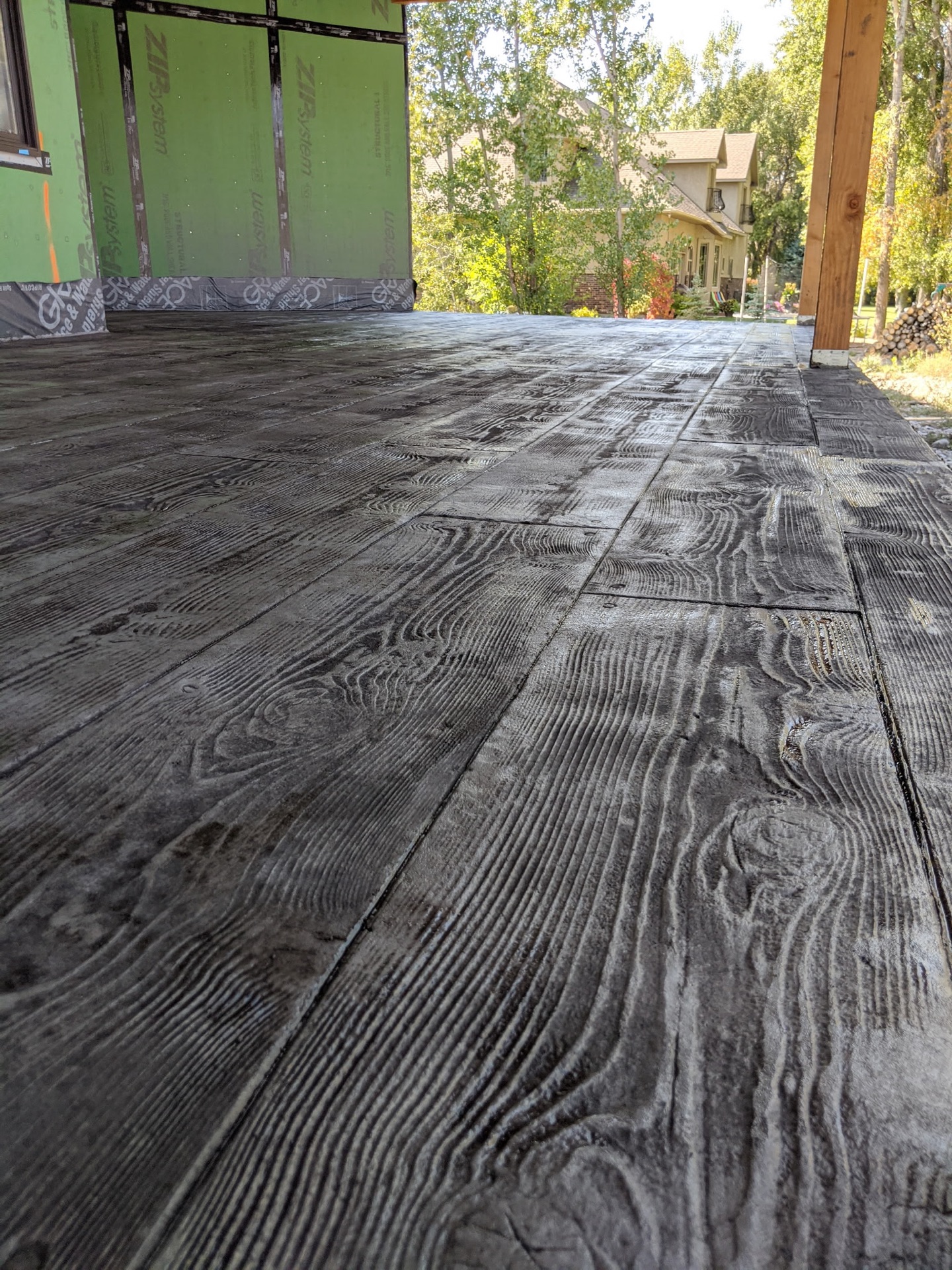
Wood plank. The most requested pattern we run right now, and it holds up well. The texture is deep enough to stay slip-resistant when wet, and the plank lines disguise control joints better than most patterns.
Ashlar slate. The classic. Wide, irregular stone pattern, forgiving on large open areas, and the seams give the slab natural places to hide joints.
Seamless texture. Subtle stone or skin texture with no repeating pattern. Good choice if you want the color and grip without the patio reading as obviously stamped.
Running bond brick. Sharp on smaller patios and walkways. On large areas the repeat becomes noticeable, so we usually break it with a border.
Skip the high-relief patterns with deep grout lines on anything that will see snow shovels. The shovel catches the pattern edges and chips them.
The sealing conversation nobody has upfront
Stamped concrete needs sealer to keep its color. That is not a maintenance upsell, it is how the product works. Plan on resealing every two to three years in our climate, and expect a cost in the range of $0.75 to $1.50 per square foot each time.
Two things worth knowing before you commit:
Sealed stamped concrete is slick when wet. If the patio wraps a pool or sits at the bottom of a downspout run, ask for a slip additive in the sealer. It costs almost nothing and it matters.
Sealer traps moisture if it goes on too heavy or too early. A thick coat on a slab that has not finished curing will cloud, and in freeze-thaw country trapped moisture under sealer is what pops the surface. Thin coats, correct timing.
For the underlying material standards, the American Concrete Institute publishes the guidance most reputable contractors in this region build to.
Stamped patio vs. a deck — the honest comparison
People usually price both. The short version: stamped concrete costs more upfront than a basic pressure-treated deck and less than a composite deck, and it outlives both by a wide margin with far less maintenance. There is no annual staining and nothing to rot.
The case for a deck is elevation. If your back door sits three or four feet above grade, concrete means building up fill and possibly a retaining wall, and the math stops working. At that point talk to a builder about a deck instead. Bryce at SwagerBuilds handles that side of it and will give you a straight answer on which makes sense for your grade.
What to check on a stamped concrete bid
Ask these four questions and you will sort the field fast.
- Rebar or wire mesh? If the answer is mesh, keep looking.
- What PSI mix? You want 4,000 minimum here.
- How thick is the gravel base, and is it compacted in lifts? Four inches minimum, more on soft ground.
- Is sealing included, and what is the reseal interval? A contractor who does not bring up resealing has not thought past the check.
Get the pattern and color selected before the pour date, not the morning of. Color samples look different cured than they do wet, and you want to have seen a real cured sample outdoors before you commit.
Frequently asked questions
How long does a stamped concrete patio take? Two to four days of on-site work for a typical residential patio: tear-out and base prep on day one, pour and stamp on day two, then cut joints and seal after the slab has cured. You can walk on it in about 48 hours. Keep furniture off for a week.
When is it too late in the year to pour a stamped patio in Idaho Falls? Our reliable window runs late April through early October. We can pour in colder weather with additives, blankets, and heaters, but stamped work specifically gets harder as temperatures drop because the finish window shrinks and the color can cure unevenly. For decorative work I would rather schedule you in spring than rush a November pour.
Will a stamped patio crack? All concrete cracks. The job is controlling where. We cut or tool control joints so the slab cracks along a planned line, and we place them where the pattern hides them. Proper base prep and rebar are what keep those planned cracks from turning into structural ones.
Can you stamp over an existing patio? Sometimes. If the existing slab is structurally sound with no significant settling, a stamped overlay is an option and runs less than a tear-out and replacement. If the slab has moved or has deep cracks, an overlay just puts a nice finish on a failing slab. We will tell you which one you have.
Does stamped concrete add value to a home? It does more for usable outdoor living space than for appraised value directly. Buyers in this market respond to a finished, functional backyard. A cracked or badly stamped patio works against you, which is another reason the base prep matters more than the pattern.
Getting a real number for your patio
Every patio quote depends on size, access, tear-out, grade, and finish. Send photos of the area, the access route for a truck, and any inspiration pictures of patterns you like, and we can get specific fast.
Need concrete work in Eastern Idaho? Call Zach at Skinner Customs — (208) 390-5794 — or start at skinner-customs.com
Content produced in partnership with S4 Media, marketing partner of SwagerBuilds LLC.