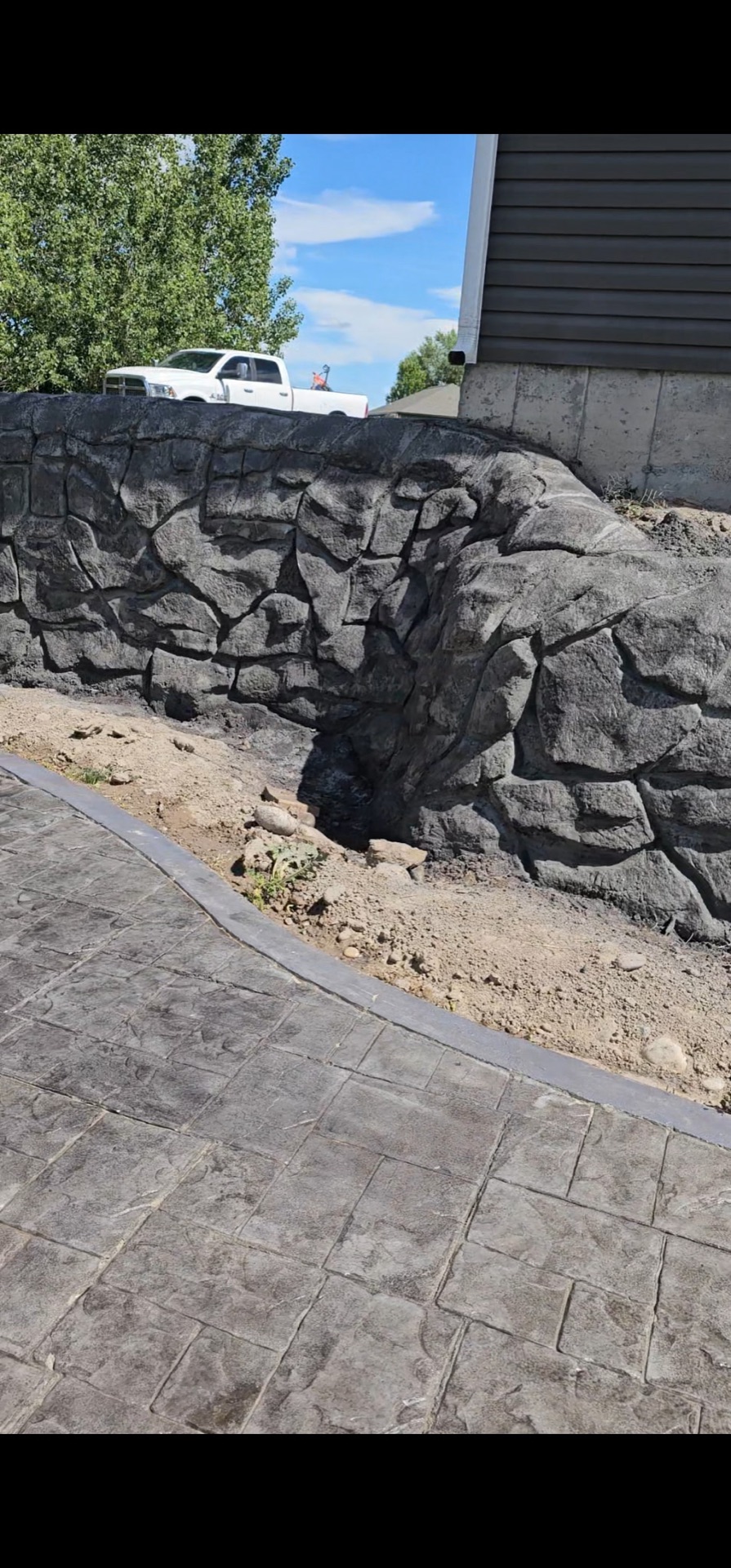
Decorative concrete in Eastern Idaho runs $10 to $22 per square foot installed in 2026, against $8 to $13 for the same slab in plain broom finish. But the number on the bid is only part of what decorative concrete costs you. The rest shows up over the next ten years, in sealer, and almost nobody puts that on the quote.
I run Skinner Customs out of Rigby, and I pour decorative work every season — stamped patios, colored drives, exposed aggregate, stamped rock-face walls. I am not talking anybody out of it. I am telling you what it actually costs to own, because the homeowners who end up disappointed are the ones who bought the install and never priced the upkeep.
What each option costs up front
| Finish | 2026 installed cost | What you are paying for |
|---|---|---|
| Plain broom finish | $8 – $13 per sq ft | Baseline: 4,000 PSI, rebar, compacted base |
| Integral color (added to any base) | +$1.50 – $3 per sq ft | Pigment batched at the plant, color through the slab |
| Color hardener (added to any base) | +$2 – $4 per sq ft | Dry pigment broadcast and floated in, richest color, harder surface |
| Acid or water-based stain | +$2 – $5 per sq ft | Applied after cure, variegated look, surface-only |
| Exposed aggregate | $12 – $17 per sq ft | Washed surface, grippy, hides staining well |
| Stamped | $14 – $22 per sq ft | Pattern, release color, texture mats, hand detail, sealer |
| Mow strip or decorative curb | $12 – $22 per linear foot | Formed landscape edging |
A release color for the secondary tone on stamped work adds $0.75 to $1.50 per square foot. On a 320-square-foot patio — 16 x 20, the size most people land on — plain broom is $2,560 to $4,160 and stamped is $4,480 to $7,040. Call the premium roughly $1,900 to $2,900.
The ten-year number nobody quotes
Stamped concrete needs sealer. That is not a maintenance upsell, it is how the product works: the color lives in a thin surface layer and the sealer is what keeps it there and keeps the pattern from going chalky.
In our climate, plan on resealing stamped work every two to three years at roughly $0.75 to $1.50 per square foot. On that same 320-square-foot patio, that is $240 to $480 each time, three to five times over ten years — about $720 to $2,400.
Plain broom-finish concrete benefits from sealing too, but the schedule is more forgiving, typically every three to five years, and nothing about its appearance depends on it.
So the honest ten-year comparison on a 320-square-foot patio looks like this:
| Plain broom finish | Stamped | |
|---|---|---|
| Install | $2,560 – $4,160 | $4,480 – $7,040 |
| Sealer over 10 years | modest, optional | $720 – $2,400 |
| Ten-year total | $2,560 – $4,900 | $5,200 – $9,440 |
Integral color sits in between and is the best value in the lineup for most people: the pigment runs through the whole slab, so when the surface wears there is more of the same color underneath, and it does not create a maintenance obligation to keep looking right.
What our climate does to decorative work
Three Eastern Idaho realities change which decorative option I recommend:
Freeze-thaw. We cycle above and below freezing dozens of times a winter. Water gets into the surface, freezes, expands, and pops off whatever is on top. Anything that lives only at the surface — stain, a thin overlay, a film-forming sealer applied too heavily — is more exposed to that than pigment mixed into the concrete.
Snow removal. A shovel blade, and especially a plow or a snowblower skid, rides on the high points of a stamped pattern. Deep, heavily textured patterns in a driveway or a walk you clear all winter will show wear at the pattern peaks. On a patio you shovel twice a year, it is a non-issue.
Deicing salt. Calcium chloride and sodium chloride are acceptable on concrete. Ammonium-based and magnesium-based products chemically attack the surface, and they will take a decorative finish apart faster than anything else on this list. On decorative concrete I would rather you use sand.
That leads to a simple rule I give people: put the heavy decorative work where you live and look — patios, front entries, courtyards, pool decks — and keep the surfaces you plow and salt simpler. Integral color in a broom finish on a driveway gives you most of the visual upgrade with none of the maintenance debt.
Where the money actually goes
Decorative work is not marked-up plain concrete. The base slab underneath is identical: 4 inches for a patio, 4,000 PSI mix, #3 or #4 rebar on an 18-inch grid, minimum 4 inches of compacted gravel. Wire mesh is the low-bid shortcut, decorative or not — it gets walked to the bottom of the pour and does nothing.
What is added on top of that is labor and timing. Stamping is done in a window measured in minutes, on the whole pour, by enough hands to finish it before the slab sets. That means a bigger crew on the job, mats and release material staged in advance, and no ability to stop and come back tomorrow. Miss the window and you own the result permanently.
That is the real reason to care who pours decorative concrete, and why a suspiciously cheap decorative bid is a bad bet. Our flatwork floor is $8 per square foot for plain broom finish. Stamped work carries genuine added labor and material above that, so a stamped bid well under $12 in this market means something got cut — usually base, reinforcement, or the sealer step that the finish depends on.
The Decorative Concrete Council of the American Society of Concrete Contractors publishes technical guidance and certification for exactly this kind of work, and it is a reasonable reference point when you are comparing contractors rather than comparing prices.
Questions to ask before you sign a decorative bid
- What is the slab spec underneath — thickness, PSI, reinforcement, base depth?
- Is sealer included in the install, and what product?
- What is the resealing interval and the cost per square foot when it comes due?
- Is the color integral, a hardener, a release color, or a stain — and which parts of the look depend on the surface layer only?
- How many people will be on site the day of the pour?
- Where are the joints going, and how will they be detailed in the pattern?
- What does the finish look like in three years in this climate — and can you show me one of yours that old?
That last one is the whole test. Anybody can show you a stamped patio the week it was sealed.
Frequently asked questions
How much does decorative concrete cost in Eastern Idaho?
$10 to $22 per square foot installed in 2026, depending on the finish. Integral color is the cheapest upgrade at $1.50 to $3 per square foot over a plain pour; stamped work is the most expensive at $14 to $22 per square foot.
Is stamped concrete worth it?
On a patio or entry you look at and sit on, often yes. On a driveway you plow and salt all winter, I usually recommend integral color in a broom finish instead — most of the look, none of the resealing schedule.
How often does stamped concrete need to be resealed in Idaho?
Every two to three years in our freeze-thaw climate, at roughly $0.75 to $1.50 per square foot. Skip it and the color fades and the surface dulls.
Which decorative finish holds up best to snow removal?
Integral color in a broom finish, then exposed aggregate. Deep stamped textures wear at the pattern peaks where a shovel or plow blade rides.
Does decorative concrete crack more than plain concrete?
No. It is the same slab with a different surface. Cracking is a function of base, reinforcement, thickness, and jointing — not the finish. What changes is that a crack is more visible in a pattern than in a broom finish.
Can you add color or a stamped finish to concrete I already have?
Stamping, no — that happens while the concrete is plastic. Staining or an overlay on an existing sound slab is sometimes possible, but it depends on the condition of the surface, and in this climate an overlay on an exterior slab has to be chosen carefully. If the slab is failing, replacing it with color or stamping built in is the longer-lasting answer.
Get a decorative number
Tell me what the area is, what you want it to look like, and whether it is something you will shovel in January or look at from the kitchen window. I will price it both ways — decorative and plain with integral color — so you can see the real gap before you decide.
Need concrete work in Eastern Idaho? Call Zach at Skinner Customs at (208) 390-5794 or start at skinner-customs.com.
Content produced in partnership with S4 Media, marketing partner of SwagerBuilds LLC.
